Thursday, December 4, 2008

Losing Flow...

from www.ebl.org/flow_original.gif

I'm auditing a sales course today and learning a lot.
Unfortunately, I'm not learning about sales.
Instead, I'm learning about flow... and how to lose it.

Mihalyi Csikszentmihalyi
identified 'Flow' as the happy place where challenge and skill reach an equilibrium. As your skills grow, the challenge should be increased.

When your skills are lower than the challenge, you get anxious and demotivated.
When your skills are higher than the challenge, you get bored and demotivated.
In the mid-range, time flies, you are energized, you learn, and you are 'happy'.

You can guess where I am right now (with most of the attendees) - below the line.
Why? The challenge is not meeting the skill of the group.

We have a lot of sharp folks in the room right now, and they're being asked to listen to a lecture.
Have you ever had to sit for three hours, listening to somewhat talk about things you already understand? I bet you have...

Please don't do it to others.
Engage the audience early. Challenge them to an appropriate degree. Have them do things!
Or they'll lose flow... and you'll lose them


Five Great Quotes about Presenting

Here are some of my favorites:

  • "It's not about having a 'good story', there is no such thing - stories are simply good or bad in the telling."
    ~ that presentation sensation by martin conradi and richard hall
  • "The only reason to give a speech is to change the world"
    ~ John F. Kennedy
  • "It is not faults that kill a talk. It is a lack of virtues."
    ~ Dale Carnegie
  • "Designing a presentation without an audience in mind is like writing a love letter and addressing it ‘to whom it may concern’."
    ~ Ken Haemer, AT&T
  • "Make sure you have finished speaking before your audience has finished listening."
    ~ Dorothy Sarnoff


Wednesday, December 3, 2008

Storyboarding for Success

I mentioned a few weeks ago that I'm rewriting one of our workshop manuals in manga/comic book format.

While I was in Cabo San Lucas last week, I continued work on the project.

Storyboarding is the easiest way for me to do this. It triggers my right brain by forcing me to think visually. It also forces me to simplify my concepts.
So, I sat by the pool with a pad of post-it notes and sketched out my ideas.

The workbook opens with a quote from Confucius - "If you must play a game, know the stakes, the rules, and the quitting time" - so you can see here that I sketched some ideas around that.

The post-it notes are great, because I can move them around, insert or delete ideas and images, or redraw one without wasting the other pictures.
Once I drew the storyboard, I went to Microsoft Clip Art and grabbed some images that matched my storyboards. Eventually, I'll acquire some more exclusive images or shoot my own, but the Microsoft art is free and represents a good start.

Here is my 'manga' version of the Confucius quote.
Had I started at the computer, it would have probably taken more time, been less clear, and less creative.

The next time you create a presentation or document, try storyboarding first. You might be surprised by the results.

One other way to utilize your storyboards, is to just import them directly into your document or presentation.
This image that depicts "Stereotypes vs. Generalizations"
could be cleaned up in Photoshop and easily dropped into my presentation.


Lawrence Lessig, PowerPoint, and Copyright(wrong)

Edward Tufte will be in San Jose on December 11th. Mr. Tufte is the author of Death By PowerPoint. He's ornery, but smart. I highly recommend you go to see him.

The internet is full of rants regarding the brain-disabling capabilities of PowerPoint.
What's not nearly as easy to find, however, is a successful use of PowerPoint supporting a coherent message.

One of the most famous examples on the net is this one - Free Culture - by Lawrence Lessig, a Stanford Law Professor and surprisingly countercultural thinker.

The use of PowerPoint here is radical (unless you think using 243 slides in 31 minutes - one every 8 seconds - isn't radical), and totally effective.
Beyond that, the message - that innovation depends on borrowing and building off the past, and that the freedom to do that is disappearing - is one you should hear and care about.

If his message resonates with you, you can download the entire (352 page) book for free.
Highly recommended...


Tuesday, December 2, 2008

Freakonomics and the Real World

"Knowing what to measure and how to measure it makes a complicated world much less so."
-Freakonomics - Steven D. Levitt & Stephen J. Dubner

Interviews for strategic planning reveal that many executives believe they lack
a) 'enough data' and/or
b) 'useful data'

Really?
This seems, to me, to just be an admission that they can't figure out what the data means.
Will more data help? Doubt it...
And what is 'useful data'? A proven answer?

Why don't more companies hire statisticians?
Probably the same reason why they don't hire philosophers and anthropologists.

"We kill what we fear, and we fear what we don't understand"


Monday, December 1, 2008

From Cabo: Time to Fly

Took one last walk of the beach this morning, before packing and heading to the airport.
Our local pelican was kind enough to pose for us.


Conscious Competence - A Path of Learning

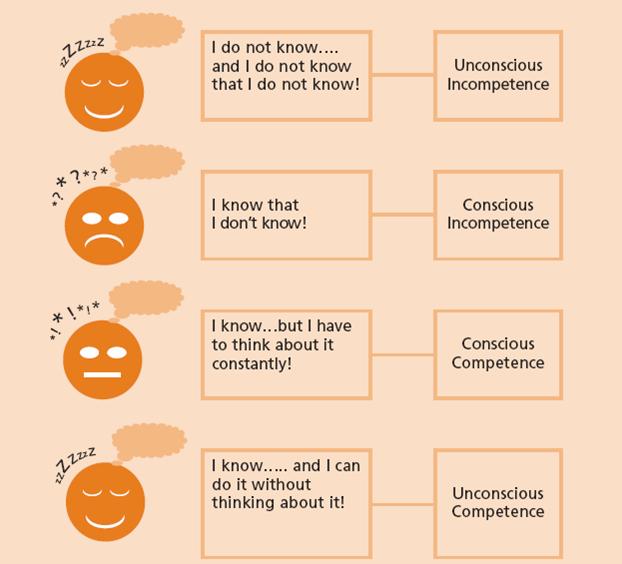
One of the most-used models in my toolbox is the 'Unconscious Competence' Model.

I find it to be an excellent model for cultural dealings.

When I first went to Japan in a state of Unconscious Incompetence, I made many, many mistakes that I only became aware of later.
I wasn't nearly humble enough, or quiet enough. I was also waaaay too casual.

I remember pointing out - at a Toshiba business meeting - that a female Toshiba engineer had a Winnie the Pooh pen. "Pooh-san", I cheerfully remarked. Needless to say, I drew silent stares in return.

Then I moved into the state of Conscious Incompetence. This was the stage when I kept wearing my shoes into the wrong places. I knew better, but I would always catch myself three steps into the wrong area. Bad Glenn! Bad!

Gradually, I reached Conscious Competence. I got the shoe culture down. I stopped pouring soy sauce on my rice. I didn't get lost on trains. But, I always had to think about it.

Finally, I reached the glorious state of Unconscious Competence (in at least some areas). Unfortunately, it was just in time to return to the U.S.
Now I found my unconscious skills allowed me to say 'Hai' to Americans, suck wind when I needed to say no, and stand around like an idiot waiting for taxi doors to open automatically.

Ah well, it's the journey that matters; not the destination.