Everyone 'knows' that Asians don't like change. It's a given, isn't it?
Well, consider this...
When I lead Change Management classes around the world, we do an exercise where everyone has to change 5 things about themselves, then 10 more, then 10 more.
In the US, some attendees will start rolling their eyes right from the start.
In Asia, the attendees dive straight in and enjoy the process.
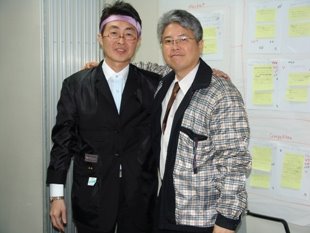
This photo of two serious, hard-working managers (In Geun Seo and Eric Han) shows how quickly they could adapt to this classroom request. Note the inside-out jackets, unbuttoned collars, and the tie around In Geun's head.
Why, you might ask, can they accept this change so easily, but resist others.
The answer, like so many things in Asia, is context.
Most of Asia is a
high-context environment. That is, everything around an event or product is just as, or more important than the event or product itself.
Packaging, introductions, relationships, surroundings, body language - all of these contribute more to your success than the value of the product you present.
As a result, when I ask people to do this exercise in the US, they question my motives. They want to know 'why' and 'how long' and 'to what purpose'. They need to understand the value of the exercise.
In Asia, the attendees look at the context. We're in a classroom. I'm a facilitator/teacher. I was introduced by the President of the organization. Therefore, what I ask must have a reason and purpose. They don't need to ask. They accept.
Next time you try to introduce change in Asia (or anywhere), consider whether you are dealing with a high or low context environment and position yourself for success.
Change can be easy to sell or hard to sell. Your choice.
 Everything changes. It's just the way of things.