Showing posts with label management. Show all posts

Wednesday, May 13, 2009

John Wooden's Pyramid of Success

When discussing leadership, you just can't go wrong with John Wooden, legendary former coach of the UCLA Bruins basketball team.


I'm a big fan of his Pyramid of Success. I may think it's a little more complicated than it needs to be, but I didn't coach 10 NCAA champions - so I'll assume he knows more than me...

Enjoy... and find more on Coach Wooden's website.


Thursday, April 9, 2009

Here Lies Treasure...

With Eric Mead at the CMOE workshop

Yesterday, my colleague Ken and I attended a two-part workshop by CMOE (Center for Mangement & Organization Effectiveness), in Los Altos California.

We spent the morning exploring "Applied Strategic Thinking", which included a strategy game called Journey for Jewels. Modesty won't prevent me from saying who won (ahem... the team I was on doubled the nearest team). The session was fun and information.  Definitely worth checking out.

In the afternoon, we spent time with CMOE's "Coaching Skills" workshop. This is one of my favorite coaching models. I first saw it about three years ago. I decided to take a refresher, since I was already there for the Strategy session.
I wasn't disappointed. CMOE has created a strong, research-based model that I use as the foundation of much of my coaching. 
I would highly recommend you take this course.


Tuesday, March 24, 2009

Situational Leadership II Brochure

In the past four years, I've learned two tools that changed my perspective on management - DISC Profiling and Ken Blanchard's Situational Leadership II (SLII).


If you have any interest in development, you find the SLII model invaluable.

Do yourself a favor, go to this link right now and download the brochure.
Read it, read it again, sleep on it, and then read it once more.

There is not a day that passes where I don't use the SLII model.
Download it now and thank me later.


Monday, December 15, 2008

Three Ways to Make Your Resume Get My Attention

Are you stressing over your resume?


If you are, I have one tip for you. 
Your resume should be a list of achievements - not a job description.

Too often, I see bullet points that read: 
  • Repaired High-Tech Equipment
  • Led Project to Repair Broken Stuff
  • Maintained Optimal Alignment of Customer Perspective
  • Responsible for Major East Coast Sales Account

Excuse me, but "yaaaaaawwwwwwn"...
When I see your job title, I know what you're supposed to do.
Your resume is a scorecard. Tell me the results!

It's simple. You:
  1. Reduced something (costs, defects, cycle time, etc),
  2. Increased something (revenue, profits, customer satisfaction, etc)
  3. Eliminated/fixed something (cancer? the line at the frappacino machine?)
  4. Or created something (for example, I invented the virtual frisbee - Catch!!)
  5. Or a combination of the above (invented a doohickey that eliminated a whatchamacallit, which reduced costs while increasing revenue - Yay!)

If you didn't do any of the above, I'll assume you just showed up every day.
Good luck selling that.

All right, let's pretend you did at least one of the above five, since the alternative is too depressing.

All you have to do is document your achievements on your resume.
Here's a few ways to do that.
  1. Quantify it: This is the easiest. You just need the numbers. Increased sales by 30%. Decreased downtime by 11%. Eliminated customer wait-time by initiating self-service fountain.
    Oh, but you say you cannot quantify how much your customer loves you...
  2. Get a Reference: LinkedIn is great for this. Get someone to say how great your are, and then quote them in your resume! Delivered "quickest response of all our contractors" (see reference on LinkedIn). It's that easy.
    Wait, you're really good, but no one knows it yet?
  3. Share a Work Sample: You can use Visual CV, YouTube, or your own website. Are you a great presenter? Post a presentation on YouTube. A great writer? Attach a white paper to your resume. I'm shocked at how few people do this...

Is that clear? 
Don't tell me. Show me.
Show me data. Show me a reference. Or show me a sample.
Thanks...


Monday, November 24, 2008

Learning From Sports: Good is the Enemy of Great

Donnie Walsh, General Manager of the New York Knicks (of the National Basketball Association, for those of you who don't follow sports) apparently agrees with Jim Collins.
Collins wrote the bestselling business book "Good to Great" and opens it by saying that "good is the enemy of great".

It's easy to see what he means. A good team or company doesn't want to take the risks necessary to become great.

Sports is a great laboratory for studying management and leadership, because the results are so easily measured and the stakes are so high. Unlike a typical business, in sports the only real success is a championship. Coaches have been dismissed for 'just' getting their teams to the playoffs year after year. Ask Joe Torre, Grady Little, Marty Schottenheimer, or Mike D'Antoni.

A case in point is the New York Knicks. Donnie Walsh is the new GM. Mike D'Antoni is the new coach. Everyone knew that this 08-09 team would be terrible, and would needd to be rebuilt from the foundation.
But a funny thing happened on the way to disaster. Coach Mike got the team playing well. They were 6-3 after 9 games. Fans were excited about the style of play and the playoffs looked within reach... until last Friday.

On Friday, Walsh traded the teams two best players, basically killing the season.
Why?
Because good is the enemy of great. This team was never going to be great. It's too flawed.
If Walsh let the team become good, then it's harder to break it up. The fans would scream.
By breaking it up early, Walsh can maintain the focus on long-term health (in this case, being ready to bid on LeBron James when he becomes a free agent), rather than short-term wins.
Pretty smart, huh?
But also pretty ballsy. Walsh is aiming for great (a shot at a championship), not good (playoff contention)

What about in your workplace?
I'm often surprised by managers who won't release 'so-so' performers to make room for new talent.
"Things aren't so bad," they reason, "We're hitting our targets".
Yeah, and you're setting a ceiling that you'll never break through.

Think about it: where is 'good enough' stopping you from being great?


Monday, November 17, 2008

The Three Steps of Managing People

One of my first managers, Merc Martinelli, taught me a lot about management.

Merc wasn't a terribly talkative guy, so I can't remember if he told me these lessons, or if I just picked them up from him. I'm guessing he told them to me...

Anyway, here's the lesson...

Managing people isn't that complicated. 
There are just three steps:
  1. Tell 'em what to do
  2. Give 'em the tools to do it
  3. Get the hell out of the way
There are managers who don't provide any of these. Run from these folks; they are not managers, they're damagers!

There are managers who tell you what to do, but don't provide tools or autonomy.
There are managers who give you tools, but don't provide goals or autonomy.
There are managers who get out of the way, but don't provide goals or tools.

There are even some managers who will consistently deliver on two of these three, but the one that's missing will kill you.

What you want (NEED) is a manager who delivers on all three. 
If you're a manager, you need to provide these.
It's not that difficult, but it is rare.

Here's an exercise:
Rate your current manager on these three steps.
Use a three-point scale of never (1 pt), sometimes (2 pts), or always (3pts). 
I'm lucky. My manager scores 8/9.
I wouldn't work for someone who scores less than 6, but I'm looking for a 7 or 8.

Then rate yourself if you're a manager (or even if you're not, you manage yourself after all...) .
How'd you do? Would you work for you?


Monday, November 10, 2008

The Leadership "Law of Threes"

You don't have to look very far in the world of sports for examples of positive and negative leadership, management, teamwork, and results.

In this piece at The National Football Post, Michael Lombardi discusses the leadership of Tom Coughlin, head coach of the New York Giants football team.
"Yes, I know he has one of the best teams, but what has impressed me about the job Tom is doing is his ability to handle Plaxico Burress and not let it affect the team. He is using a very simple leadership strategy called the “Law of Threes”. On each team there are three types of players. The first are the ones that will do anything that is asked, willing to help the program. The second group are the undecided players, the players that are not sure what to do. And the third are the malcontents. These are the players that want to buck the system all the time, and try to breakdown the team. As a leader, there is a tendency to try and win over the players in group three, by trying to make them happy. But all that does is move the players from group two into group three, and cause you to start to lose the players in group one. What Coughlin has done is focus on group one. He pays no attention to group three and what has resulted is that Plaxico is on an island and no one wants to join him. The team is bigger than Plaxico."
*Thanks to ESPN.com's Bill Simmons for pointing out this article*

Good leadership is usually good behavioral psychology (so why isn't that an MBA class?).

Do these three groups exist in your company or team?
How are you (or the other leaders) handling the situation?

I have to admit, I've never heard of these three laws before. An internet search only brings up references to this article.
But it makes good sense... maybe the "Law of Threes" is worth a try?


Friday, October 31, 2008

Great Books at Bargain Prices

I get nothing for this...


But, I'm filling in my Peter Drucker collection at BookCloseouts.com, and found that a number of my most frequently recommended business (and related) books are available at great prices.
So, I'm passing along the news:


Monday, October 13, 2008

Connoisseur's Guide To The Mind

In the midst of some fall cleaning this weekend, I dropped off two big boxes of cd's and dvd's at Rasputin Music.

They gave me $311. I spent $215.
Clearly a symbiotic relationship...

It was a good haul, with used copies of

I also did some sorting in my bookshelf.
While doing so, I came across "The Connoisseur's Guide To The Mind" by Roger C. Schank.

Schank, an artificial intelligence expert and major foodie, explains how we think and remember, by telling us stories about his most memorable meals.

My favorite quote:

"Learning about food means eating it, thinking about what you ate, eating things like what you have already eaten in order to contrast one experience with another, and asking questions to determine other information that may help you make sense of your experiences.
This is how learning works. "

I lead management workshops, so I applied Shanks' theory to management.
"Learning about management means managing people, thinking about the results of managing people, managing people using other tools (or other people) like what you have already used in order to contrast one experience with another, and asking questions to determine other information that may help you make sense of your experiences.
This is how learning works. "
Interestingly, most of us never use this process with eating. We just eat without learning.
Similarly, most of us never use this process with management.

We manage as if it were a mechanical action like eating or sleeping.
And wonder why we don't learn...


Monday, October 6, 2008

Book Review: "Overcoming the Five Dysfunctions of a Team – A Field Guide" by Patrick Lencioni

I’m on record as hating, wait, no… make that HATING management books that are written as ‘fables’, ‘parables’, ‘novelettes’, or that look remotely like children’s books.

My skeptic-meter goes straight to red when I see books like “Whale Done”, “Who Moved My Cheese”, “The Offsite ”, “Our Iceberg is Melting”, or any of Patrick Lencioni’s ‘Leadership Fables’ in the business section of my favorite bookstore.

Obviously, that’s my problem, as many love the story format. By not reading these books there’s a risk that I’ll miss out on some good ideas.

In the case of “The Five Dysfunctions of a Team” that’s exactly what happened. I tried to read the book three times, laughed my ass off by the end of page two (and not in a good way), and put the book down. As a result, I missed out on a very useful model.

Fortunately, this Field Guide was released for folks like me.

Title: "Overcoming the Five Dysfunctions of a Team"
Author: Patrick Lencioni
Genre(s): Business, Teams, Training, Facilitation
Summary: to quote the back of the book - "practical guidance for overcoming the Five Dysfunctions"

Favorite Quotes: I'll give you three:

  1. The key ingredient in building trust is not time. It is courage."
  2. "Lack of conflict is precisely the cause of one of the biggest problems that meetings have: they are boring."
  3. "Peer pressure and the distaste for letting down a colleague will motivate a team player more than any fear of authoritative punishment or rebuke.”

Strengths: The model is clear and intuitive. It resonates. Lencioni gives concrete examples and actions for overcoming the dysfunctions.
Weaknesses: It’s boring, where's the drama? No, I kid… I kid... Seriously - this book is perfect. Pair It with Lencioni’s hugely entertaining DVD and you’ve got a winning workshop for your team.

Conclusion: The ‘Five Dysfunctions’ is one of my (and my clients) favorite workshop tools. This Field Guide delivers the model effectively, with no fat.

Post-it Flags: 21 flags
* Each time I find an interesting quote, model, image, or idea in a book, I mark it with a Post-it flag. The more flags, the more value I found in the book.


Monday, September 29, 2008

Five Steps to Better Performance Management

It's performance review time at our company - you can smell the fear and depression in the air.

How have we managed to turn something that should be good - some feedback on your performance, a discussion about next year's goals, and a little extra money - into something that almost no one appreciates?

Do you dread performance reviews? Either giving them or getting them?
Well, you don't need to. Here are five steps to making your performance reviews less painful and more productive.

1. Set Expectations in Advance
If you don't do this... don't even bother with the other four steps. It's critical that you let people know what constitutes performance at a 'meets expectations' or 'exceeds expectations' level.
Two cases in point:

  • You ask your team to reduce costs by 20%. They succeed, hitting 21%. Does that performance merit a score of 'needs improvement', 'meets expectations', 'exceeds expectations', or 'far exceeds expectations'.
    The answer, of course, is 'meets expectations'.
    I can guarantee, however (because it's happened to me), that a team where expectations have not been set will score themselves as 'exceeds' or 'far exceeds'. It's human nature. Clearly articulate the target for 'exceeds' and 'far exceeds' and you won't have this problem.
  • My favorite example - We have a category on our reviews for 'safety'. Every year, every direct report of mine gave themselves a 'far exceeds' for safety. I held a meeting and explained, "If you save a life, you get 'far exceeds'. If you kill someone, you get 'needs improvement'. Otherwise? You get 'meets needs'. Are we clear?"
    Everyone said yes. And then gave themselves 'exceeds' or 'far exceeds'.
    It took me two years to reprogram this behavior.

One more key point. Make clear that a 'meets expectations' is good!
Grade inflation has pushed us to a point where no one is happy unless they get an 'exceeds expectations'.
Set expectations. It'll save you a lot of trouble down the road.

2. Embrace the Bell Curve

This is probably the most difficult part of performance reviews. Everyday, a manager comes to me and says, "Everyone on my team exceeded expectations! How can you expect me to punish them just to fit a Bell Curve."
My response?

Bullshit.
Show me a team or company where everyone is performing at the same level, and I'll show you a mediocre team or company.
In 20 years, I've never been on a team where everyone exceeds.
If they did, the expectations were too low.
This isn't Lake Wobegone.

I don't have enough room to argue or convince you on this, so go do some reading.
Learn about normal distribution. Read up on Pareto.
Study some motivation theory and see how you're killing your best performers by rewarding the others equally.
Until you get over the "every one's a winner mentality" (how about, "every one's a winner, but not everyone wins"?), you won't be a great performance manager.

3. Write (real) SMART goals
SMART goals are like sex. Everyone talks about it, but no one seems to be doing it enough.

Write SMART goals.
Make them unambiguous, challenging, and measurable.

4. Review results (at least) quarterly.
I'm shocked at the number of managers who have this discussion only once a year. And then are surprised that the employees are surprised!

Hold reviews against the performance objectives at least once a quarter. Agree on the results.
By the end of the year, the score is already decided (and agreed upon).
A performance review then becomes a coronation ceremony and an opportunity to discuss the upcoming year - not the past year.

If your SMART goals are tied to a strong feedback system, there's no reason why reviews cannot happen weekly.

If you're an employee, take control of this. Review your performance with your manager more frequently, and I can guarantee that you'll have better results and get better reviews.

5. Enjoy the process
Just a gentle reminder. This whole process is supposed to be motivating and rewarding.
If it isn't, why bother?

Treat it like fantasy football! If people can sit around getting excited about the statistics of football players they don't know, why can't we all get excited about the statistics of people we know and care about?

What are your tips for Performance Management?
Share them with us...


Monday, September 15, 2008

Will your job be offshored?

It depends on how much value you add.

I'll propose this simple litmus test:

Can your job be drawn on a flow chart?

If the answer is 'yes', then I can tell you now that your job is going to be:

  1. outsourced, or
  2. automated, or
  3. outsourced and then automated

Don't believe me? Look at every job you've seen outsourced or offshored.
I'll bet you can draw the tasks of that job in a flowchart.
Now look at the jobs that are 'safe' - most of them can't be flow charted.... yet.

Can you flowchart phone support? Yep, most of it anyway.
Can you flowchart in-store support? Pretty hard to do.

My solution? Flowchart your job and - as the Red Hot Chili Peppers say - "give it away, give it away, give it away now".
Seriously. Then start doing stuff that isn't on the chart and can't be charted.
Then, as soon as you get it structured, give that away, too.

It's time to sail off the chart. We've got to be explorers now.


Thursday, September 4, 2008

Mindmapping huesworks

click image to enlarge

Here's a mindmap of huesworks. I created it at bubble.us.
It's a cool, easy site to use.

Row one lists five areas of focus.
I spend most of my days exploring and working in these areas.
This blog will focus on these areas as well.
  • MLT - Management, Leadership & Teams
  • LT - Learning and Training
  • CIT - Creativity, Innovation & Thinking
  • DC - DesignComm or Design in Communication
  • GC - Global Culture

Row two lists resources and activities that I leverage in my exploration of these areas.
A number of them, like books, occur in all areas.

Finally, row three lists my offerings or outputs in these areas.
You'll find more information about these from the offerings tab at the top of this blog.


Wednesday, July 23, 2008

How Much Strategy?

I'm working with a group of directors who are responsible for an area that is tactically focused.
We've been gathering to determine a long-term vision for the team, and they are feeling some frustration during the process.
Now, most vision exercises are frustrating - if not, then you're probably not challenging yourself enough - but this one seems more painful than usual.

Every time we start to break through to a strategic discussion, it seems we can't stay there for more than 15 minutes before one of the members is compelled to dive back into a specific tactical point.
Last week, we discussed the fact that thinking strategically is like a muscle, if you don't use it, it atrophies. One member then suggested working on this for the next 6-9 weeks and you could see rolled eyes and hear some groans.

This prompted a question from me - how many hours a week should a director spend on strategic thinking? 2 hours a week would mark less than 5% of their time (I don't know any Director level employee who puts in less than 40 hours/week - certainly not these guys).

So, is 5% too much? Not enough?

How much time should a director spend?
A manager?
A VP?
A GM?
Who owns strategic thinking? And why is it so hard for most people?

Tell me what you think...


Wednesday, March 22, 2006

Engaging the Singaporean Workforce

This was the first trip I've made to Singapore since I saw the Gallup Q12 data that showed Singapore having the least engaged workforce in the world.

Marcus Buckingham makes a pretty big deal out of it in his TLC presentation, roughly saying, "When they offer you that great job in Singapore, don't take it".
The statement, like many of Marcus' statements, draws a big laugh (dry British humor wins the day, again).

Gallup reports that only 4% of the Singaporean workforce would call itself 'engaged' (compared to 29% in the US, or 9% in Japan, at the time).
Since I lived in Singapore for two years, everyone asks me, "Is it true? And why?"

Well, yes. The data has the ring of truth to me. Why? I'll try to answer that. 

First, I wanted to know how Singaporean workers would respond to the data.
I showed the data to my friends, including the HR director, and asked, "Is it true?"
After a moment of silence, they nodded. "Yes".

Does that mean you shouldn't take the job in Singapore?
Are you kidding? Take the job, I say!!
When the management bar has been set that low, you can't fail.

Want to make a difference? Go to Singapore and engage 5% of your employees (or better)...

But there's still the nagging question - Why would only 4% of Singapore's workforce consider themselves 'engaged'?

In 1997, I was managing a young, new Customer Service group in Singapore.
I'm the kind of manager who tries to catch people 'doing good' and then reinforce that behavior, so I walked around a lot, looking for the type of behavior I wanted to see and complimenting it.
More than once, people commented on how much praise I delivered. They weren't used to it. It scared them.

One Monday morning, at a staff meeting, I called out the extraordinary efforts an engineer made to get a specialized oscilloscope from a vendor. This allowed him to fix a difficult issue that was critical to our customer.
This, I said, is the type of initiative that makes us part of the solution, and not part of the problem.

After the staff meeting, my Singaporean manager called me into his office.
"Glenn," he said, "I want to give you some feedback".
Sure.
"We don't give compliments in Singapore. You'll need to stop."
Ummm... please explain.
"Well, if we compliment our workforce, they will think they are good."
Okay, I'm with you so far.
"If they think they are good, they'll want raises and promotions. And then they'll leave."

I see. Let's assume that's true. Let's agree that complimenting will drive out employees.
How is the 'no compliment' scheme working out for you.

Well, turnover in the group at that time was about 20%.

I decided that I couldn't do much worse than that by giving compliments.
I'm a guy who's unafraid of failure. In fact, I welcome failure if I can learn from it.

One thing I can't stand, however, is making the same old mistakes.
If I'm going to fail, I want to fail in new and interesting ways.

So, my manager and I agreed to disagree, and I went on with my positive ways.

Result - in two years. I lost only one employee, who I actually encouraged out (great guy, wrong place).

Note - this pattern repeated itself over the next 5-7 years.
Chinese Manager - high turnover
Western Manager - low turnover
In other words, it wasn't any magic gift I had..... (damn...)
So, what was it?

Over those two years, I interviewed many engineers who wanted to work for me.
I always asked the standard interview question, "Why do you want to work for KT?"
Some answers -
-"You are an American company"
-"You are Caucasian"
-"You are not Chinese"
-"I want to work for a Western Manager"

These responses always came from Chinese Singaporeans, and came often enough to create a pattern.

My read on this?
I think a combination of status, hierarchy, fear, and freedom created a conflict.
The East/West mix of Singaporeans means that hierarchical structures and relationships are often in place, but the workers are westernized enough to not like it.
  • Sometimes that manifests in a "I'll get promoted so I can boss them around" thought process (If you can't join them, beat them).
  • Other times it results in "I'll work for a Western Manager". On average, a Western Manager will provide a more nurturing, involving, rewarding environment for a Singaporean worker.
  • Or it just creates surrender.

But not an 'engaged' workforce.

I'm sure there are 100 other reasons for the 4% result.
But I'm also sure that any manager in Singapore who makes an effort to get positive responses from his team on Gallup's 12 Questions will be, as Marcus Buckingham says, 'an employer of choice'.


Tuesday, March 7, 2006

Managing Change in Asia...

Everyone 'knows' that Asians don't like change. It's a given, isn't it?

Well, consider this...
When I lead Change Management classes around the world, we do an exercise where everyone has to change 5 things about themselves, then 10 more, then 10 more.

In the US, some attendees will start rolling their eyes right from the start.
In Asia, the attendees dive straight in and enjoy the process.

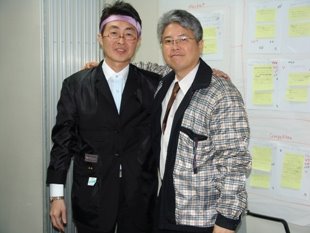
This photo of two serious, hard-working managers (In Geun Seo and Eric Han) shows how quickly they could adapt to this classroom request. Note the inside-out jackets, unbuttoned collars, and the tie around In Geun's head.

Why, you might ask, can they accept this change so easily, but resist others.
The answer, like so many things in Asia, is context.

Most of Asia is a high-context environment. That is, everything around an event or product is just as, or more important than the event or product itself.
Packaging, introductions, relationships, surroundings, body language - all of these contribute more to your success than the value of the product you present.

As a result, when I ask people to do this exercise in the US, they question my motives. They want to know 'why' and 'how long' and 'to what purpose'. They need to understand the value of the exercise.

In Asia, the attendees look at the context. We're in a classroom. I'm a facilitator/teacher. I was introduced by the President of the organization. Therefore, what I ask must have a reason and purpose. They don't need to ask. They accept.

Next time you try to introduce change in Asia (or anywhere), consider whether you are dealing with a high or low context environment and position yourself for success.

Change can be easy to sell or hard to sell. Your choice.