Showing posts with label leadership challenge. Show all posts

Monday, January 4, 2010

I'm Back Again...

It's been a crazy two months:

  • My home pc died in late October. I played with it for about a month. I got it to breathe again, but never got it to work with the internet. I finally gave up last week.
    Good news - I was able to save all my files.
    Better news - I have an excuse to buy a new computer in March.
  • I graduated with my Masters in Adult Education and Training. I wrote my action research paper over the last 10 weeks. I learned that I like learning a lot more than I like recapping my learning.
  • Work picked up. Suddenly, in September, our classes started filling up. Budgets are back. I've been teaching at least three days a week, which is great.
  • slide:ology exploded onto our scene at work. I've been leading at least one workshop a week. The Duarte approach is changing our culture.
  • I've got a two-month Tour of Asia coming up. More about the trip later, but planning that hasn't been easy.
  • My Training. I attended Decker Made to Stick Messaging, Leadership Challenge (where I 'slideologized' their deck), and Influencer. I would recommend all of these. I'll write more about them in the next week.
  • Projects. We're working with Rick and Mary Gilbert of Power Speaking on "Speaking to the Big Dogs 2.0", and with Ed Muzio of Group Harmonics on "Make Work Great". Randy Emelo and I have also released the first four installments of our six part series on the Mentoring Conversations Model.
  • Thanksgiving? Christmas? New Year? Yep, dealt with all of those - plus a nasty cold that put me down for about 72 hours during the holidays.

Apologies to any and all that I've neglected during this time.

All-in-all, it was a hectic end to a pretty great year, but I'm back again.


Saturday, March 7, 2009

Facilitating with Card Decks

If you've missed it, Dave Gray (of XPLANE) and I have been having a dialog in the comments section of my XPLANE Discovery cards post. The conversation has rotated around facilitation card decks like the Discovery cards, IDEO's method cards, Roger von Oech's Creativity cards, etc...


Dave made an interesting comment that he thinks these card decks derive their inspiration, "not from playing cards, like Pokemon, Tarot and the good old Bicycle deck, but rather from recipe cards. Each card is essentially a recipe, to be pulled from the deck when it can be useful and executed".

I think he's on to something, but I would suggest there's more to it than that.
I rarely think without a pen in my hand (the running joke at work is to hide the white board markers if you want to shut me up... but it doesn't work!), so I put together the above diagram of Facilitation tools.
The diagram includes the card decks I use most often, plus kinesthetic modeling (building models with clay, etc) and photo facilitation (using imagery to stimulate thought and conversation).

As you can see, this conceptual model has 2 axis, with 4 points.
  1. One continuum spans from tools that are Mysterious/Provoking at one end, to tools that are Clear/Reminding at the other end. Oracles at the top, Plain English at the bottom.
  2. The other continuum spans from Directing (the tools are pushing ideas and stories at you) to Listening (the tools are pulling ideas and stories from you)

Based on these continuum, there are four types of tools:
  • Recipe Cards - I love this analogy from Dave, and it fits the model. These cards are clear. They might be reminding you of possibilities that you already knew. They are directive, with some level of instruction. Recipes shouldn't be mysterious and - typically - aren't meant to be inspiring. They might inspire you, but that's a result of how you use them - not a design of the recipe (unless your recipe cards are fragmented and you can mix and match - but then it's not really a recipe). Everyone who uses a recipe should get a similar process.
    I would put the IDEO, ThinkPak, and 36 Stratagems cards here.
  • Externalization Engines - These are tools that are meant to pull stories and ideas out of you. But they're clear. They are not meant to require deep interpretation. These are often cards that are sorted into 'yes/no', 'hit/miss', 'good/bad/neutral' piles.
    The Leadership Challenge Values Cards are a perfect example. They are a set of cards with values listed on them. The user does a quick sort to identify and prioritize their values and then discuss them. It's what I call an externalization engine.
    I would put the XPLANE Discovery cards here as well. They are used in a sort, they pull stories and thoughts from the user, and they are very clear. The cards do provide some direction, so I push them closer to the center of the grid.
  • Muse Devices - These are also intended to pull stories and ideas from the user, but these are NOT clear. Everyone will have a different interpretation. These are, basically, oracle devices.
    I place Kinesthetic Modeling here, along with Oblique Strategies (thanks Dave! I ordered two sets. I also see there's an iPhone application for them) and my Tao Te Ching cards.
    Photo Facilitation sits in the middle of Muse and Externalization, because the images are concrete (clear) but can be interpreted differently (provoking).
  • Mentoring Devices - First, I'm not in love with the label 'Mentoring', but I'll live with it for today. Mentoring devices are directive, but not necessarily clear. They are for people who need a push towards possibilities, not old methods.
    Roger von Oech's card decks fit here. A line like "Ask a fool - to dislodge assumptions", is directive, but counter-intuitive to some, and begs the interpretation of a 'fool'.

Why did I spend the past two hours building this model? That's what my wife just asked me when I tried to convince her that it was really interesting...

Well, as a facilitator with a box full of tools, I like to have a framework that helps me decide when to use a particular tool.
Second, a framework like this helps me decide if I have full coverage from the tools in my kit (it looks like I do).
Finally, this framework helps me work with others - both my peers, and more importantly, my clients. Discussing this model with a client would allow me to decide which tool is appropriate and obtain their buy-in.

Well, it's a new model, so feel free to kick the tires and rip it apart. 
What tools am I missing? 
Is there a better way to draw it?
Disagree with my labels?

Let me know...


Thursday, October 9, 2008

Drinking from the Well - Redefining Leadership Development

Hanging Out with Barry Posner (front right) and the Gang

Today, I attended the "Redefining Leadership Development" Forum at Santa Clara University.

The event was organized by my friends at Sonoma Learning Systems, and they did a great job. Kudos to Daren Blonski (who has a new twitter blog listed below) and Jeni Nichols!
I enjoyed seeing a number of old friends and making a few new ones.

The morning opened with Barry Posner (co-author of The Leadership Challenge and Dean of the Leavey School of Business at Santa Clara University) speaking about Sustainable Leadership.
I've been aware of The Leadership Challenge for about 10 years, first from reading the book, second from attending the class, and then by getting certified as a facilitator of the workshop. 
Despite my familiarity with the material (or maybe because of?) watching Barry was like drinking water straight from the source - fresh and energizing.

I'll share three notes I took from Barry's talk:
  1. Commenting on the research that shows that our role models come from those who are closest to us - "The Question is not 'Do I matter?', but 'How do I matter?'."
  2. "Leaders are always present, even when they're not... because they're always in the followers mind..."
  3. Barry drew a correlation between personal values and scuba diving - "When a scuba diver gets disoriented, the advice is to release some oxygen and follow the bubbles. The bubbles provide direction to overcome the disorientation. Our personal values do the same thing. They provide direction during times of disorientation."
    I love that analogy.

Next up was Andrew Jefferson (President of Fort Hill company and co-author of The Six Disciplines of Breakthrough Learning). Andrew spoke about the road map for optimizing the impact of leadership training.

Here are three notes I took from Andrew's talk (I recommend getting his book, listed below):
  1. "Learning program objectives should be expressed in business outcomes."
  2. Quoting research from Ninth House, "The true impact of a Learning program is best predicted by the climate the participant returns to..."
  3. "When the manager is actively involved, we see significant improvement in the learner. When the manager is not involved, we see no or minimal improvement."

After the session, Barry Posner offered us a tour of Lucas Hall, the beautiful new (opened Sept 14th) home of the Leavey School of Business. In the short time that we were with Barry, he modeled the Five Practices of The Leadership Challenge
  1. Model The Way - Prima donna author? No way... 
    I caught Barry cleaning coffee cups and bagel plates from all the tables during a break and made a joke about it. He humbly deferred and changed the subject.
    Seen many CEO's engage like that lately?
    Didn't think so...
  2. Inspire a Shared Vision - As Barry walked us through the rooms, he painted a picture of Hall in full use. He described paintings and full classrooms. He was clearly jazzed about this place. His enthusiasm was contagious.
  3. Challenge The Process - One member of our group commented on the color scheme - another topic close to Barry's heart.
    He stated that the common color of Santa Clara is 'drab brown' and how he pushed for bursts of color to be splashed through the hall.
    "Not everyone likes it, but I thought it was important", he said.
  4. Enable Others to Act - Barry used first names at every opportunity, gave credit to others, thanked sponsors, and pointed out how the lobby was designed to promote the Jesuit value of 'service to others'.
  5. Encourage The Heart - He showed us the 'Kouzes and Posner Terrace', where every Thursday at Three, the staff goes to the Terrace for Thirty minutes of communing in the (usually) spectacular California weather.
    It's an event that builds relationships, shows appreciation and energizes the team.
    *the photo above is from this terrace*

These behaviors shouldn't be a surprise from a co-author of The Leadership Challenge, but... 
it's nice to see someone practice what they preach!

Links of Interest


Thursday, September 4, 2008

Mindmapping huesworks

click image to enlarge

Here's a mindmap of huesworks. I created it at bubble.us.
It's a cool, easy site to use.

Row one lists five areas of focus.
I spend most of my days exploring and working in these areas.
This blog will focus on these areas as well.
  • MLT - Management, Leadership & Teams
  • LT - Learning and Training
  • CIT - Creativity, Innovation & Thinking
  • DC - DesignComm or Design in Communication
  • GC - Global Culture

Row two lists resources and activities that I leverage in my exploration of these areas.
A number of them, like books, occur in all areas.

Finally, row three lists my offerings or outputs in these areas.
You'll find more information about these from the offerings tab at the top of this blog.


Wednesday, September 3, 2008

offerings@huesworks

Glenn delivers the learning profession's most highly regarded programs - such as Situational Leadership II®, The Leadership Challenge® Workshop, and Six Thinking Hats® - around the world.

The offerings in Glenn's toolbox can be mixed and combined to create comprehensive programs.


SMART as Hell!

SMART as Hell teaches individuals how to take control of their own success in work and life. Anyone who writes goals or is asked to meet goals needs this workshop.

Sessions include:

  • A step-by-step process for writing goals that are SMART as Hell!
  • The SMARTometer - the worlds first tool to measure how SMART a goal is.
  • Case studies from a variety of organizations including businesses, the military, the public sector, and even the Obama campaign.


CultureCoach

Today, business challenges are often synonomous with cultural challenges.
  • Worried about your first business trip to Asia?
  • Getting ready to live overeseas?
  • Having problems with business cross-culturally?
  • Need assistance getting the most out of your global team?

These are just a few of the scenarios that Glenn coaches his clients through. Whether it's a single session to prepare for a meeting tomorrow, or extended coaching for working cross-culturally - Glenn will help you get results.

CultureCoach is also available as a workshop for cross-cultural teams.

Glenn is a graduate of Coach U and a member of the International Association of Coaching.


DiSC Profiling

Ever wonder why your boss, your employees, your peers, or your customers behave the way they do? Ever wonder what you can do to help them accomplish their goals?

DiSC is a model that shows you how to understand normal human behavior - for yourself and others.

With this tool, Glenn helps you build work relationships, customer satisfaction, and stronger team dynamics.


Edward de Bono's The Six Thinking Hats®

Productive group thinking is a rare thing. Conflict or debate are more common, and rarely produce optimal results.

Glenn is a certified instructor of Edward de Bono's Six Thinking Hats® - a simple, effective parallel thinking process that helps people be more productive, focused, and mindfully involved. Six Thinking Hats® yields stronger ideas in less time.


Global Presentation Skills

Some people will tell you that there are no shorcuts in life.
They're wrong.
Poor presentation skills will destroy the best plans, and strong presentation skills will give you an advantage over your peers.

If you want to create change, you'll need to communicate that change and communicate it globally.

This workshop - built around the premise that people want 'conversations, not presentations' - will provide you with the tools to communicate your message in a format that will be successful around the world.


High Performance Teams

Have you ever enjoyed the 'buzz' of being on a great team?
Glenn relishes the challenge of facilitating a team to the next level, and utilizes his wide range of experiences in team environments.
  • Sports - coaching baseball, playing football, hockey and volleyball
  • Water Expeditions - In Baja Mexico and Utah's Green River
  • The Asia workplace - Which has a special perspective on what 'team' means
  • Corporate Management - building and coaching teams

In customized High Performance Teams sessions, Glenn guides teams through a discovery and identification process and then facilitates the team to create an actionable roadmap for championship performance.


Innovation Workshop

Looking for a spark?
Creativity is not magic. It is a game with clear rules. Unfortunately, most organizations don't know those rules. Even when they do, they're unlikely to follow them.

Glenn often is called on to create an environment where even the most 'uncreative' team can produce new, business-ready ideas.

As someone who has designed dozens of released offerings and must be ready to improvise in any setting, Glenn is uniquely suited to help teams produce innovative results. Glenn also exercises his creativity through music and photography - some of which appears on this site.


Managing & Leading Globally

There are only two types of management skills - navigational skills and survival skills.

When you don't have navigational skills, you need to develop survival skills. When you have great navigational skills, you may not have developed survival skills for when they're needed. To be a flexible leader, you must first have both of these skills

Glenn works with individuals to develop the navigation and survival skills necessary to be a great manager. Then, Glenn guides them through the self-reflection necessary to be a great leader.


The Leadership Challenge® Workshop

Approaching leadership as a measurable, learnable, and teachable set of behaviors, this proven leadership model proclaims Leadership Is Everyone’s Business.

The workshop, combined with the Leadership Practices Inventory - a validated 360-degree tool - provides the framework to become a better leader.

Glenn is a Level I Facilitator of The Leadership Challenge® Workshop.


Maximizing Customer Relationships

How strong is the link between you and your customers?

Maximizing Customer Relationships shows that 'caring' is not a soft skill - but rather a tangible component of the service experience. In the workshop attendees see how 'care' can be measured and delivered to customers - providing greater returns for everyone.


Problem Solving the 7-Step Way


Problem solving is the most fundamental of business skills, but many of us are poor at it. A review of most problem solving efforts will show that they take more time, money, effort, and rework than was necessary.

Root cause analysis is the most effective method for permanently solving problems.

Glenn leads teams and individuals through a 1-day workshop, with a case study, to learn the 7-step methodology. He also provides coaching and facilitation to assist in reinforcing the skills.


Situational Leadership II® Workshop

Ken Blanchard Companies' Situational Leadership II® is the most comprehensive method of managing and developing people in the world.

Glenn is a certified instructor for this 2-day session.

More importantly, he is a passionate user of the model - with his clients,
students, employees, and himself.

Glenn can be reached at glenn_hughes@hotmail.com.


Wednesday, July 30, 2008

A few more notes from Sonoma...

Here's a group that you'd like to spend more time with... in a place you should spend time in.

I have to say this... Sonoma is very cool. I'd never been there until a month ago.
It's got great restaurants, great wine (obviously), a beautiful town square, and nice people.

In this picture, our Leadership Challenge group and our hosts from Sonoma Learning Systems are combining all of the above (except the restaurant, which came later).

If you can make it to Sonoma , make sure to be there for the Tuesday night farmer's market.

In addition to live music, a great 'local' vibe, and some of the best flavored honey I've ever tasted (we bought two bottles of cinnamon honey and one of raspberry honey... yummm), Sonoma may be home to the world's best corn dog.

Here's Angie, modeling the Sonoma Spicy Cajun Corndog.
It's big. It's spicy. It's juicy.
It's got an awesome coating - not greasy or oily.

Everyone told me it would be incredible.
I didn't believe them... but they were right.

If you like corn or dogs or any combination of the two, go to Sonoma and get one...


Tuesday, July 29, 2008

From Sonoma: PREP

I finished the Leadership Challenge Workshop Advanced Facilitator Training today. It was a great experience.

Sharing energy and ideas in a room full of professional facilitators is a remarkable thing. As a group, everyone was open, curious, and authentic. 
How often can you say that about a room of 20 or so human beings? Seriously... two days of laughs, debates, hugs, bawdy language, and - oh by the way - deep learning.

Two of the participants in this session were instructors in my previous session. How is that for modeling humility and curiosity?
Kudos to Sonoma Learning Systems for the great event.

I've worked with KT for 20 years, so I haven't seen much of the outside corporate world. Sometimes, I'm surprised what I learn when I step out.
Today was a case in point. We had an 'under the gun' Q&A test as part of the event.
A facilitator stands up, and the master facilitator asks a mystery question. The facilitator gets 5 minutes to answer.

In our corporate learning group, we use a tool called 'PREP' to answer impromptu questions. I used it today and it went well, so I shared it.

PREP simply stands for

P - My Position is...
R - The Reason is...
E - Let me give you an example...
P - So, in closing, my Position is...

The first and last lines leverage two concepts.
1) clarity - tell them exactly what your position is. Don't make them search for it
2) primacy/recency - people remember the first and last things you say, so make them the same thing

Next, give a broad theoretical reason. Don't bog down in details. Give a framework that the brain can hold on to.
Then, deliver an example that fits your framework. The brain is so ready for your example now, that it goes down like lemonade on a hot summer day.
By the time you return to your position, you've got them hooked. PREP is literally, cognitive candy. It gives the brain what it wants.

Here's a live example to the question "What's the best tool I've ever learned?"

My position is that PREP is the best tool I've ever learned.
The reason I say that is because it's good for the user, good for the audience, and can be used in many settings.
Let me give you examples. PREP is good for the user because it provides a framework for answering. With a framework in place, the user can focus on content.
PREP is also good for the audience, as it provides signpost phrases that 'remove the heavy lifting' for the audience.
Finally, PREP can be used in many settings, like speeches, casual conversation, meetings, and written responses.
Again, my position is that PREP is the best tool I've ever learned.

Try it and let me know how it works.


Monday, July 28, 2008

Advanced Leadership Challenge

We're in Sonoma, California this week.
It's a Leadership Challenge Workshop filled with advanced facilitators.
It's a very tough crowd, and that's a good thing. We learn a lot from each other.

As I've challenged myself to write a haiku everyday this week, here's todays.

facilitators
teaching each other content
leadership challenge


Friday, July 25, 2008

Back to Sonoma

We're in Sonoma for the weekend, for a follow-up to Leadership Challenge.
I'll spend two days in teachbacks, and get the chance to see how others present the material.
I learn a lot every time I watch someone else facilitate, so this should be great (and the wine isn't a bad thing either)...


Wednesday, July 2, 2008

What Centers You?

At the Leadership Challenge Workshop last week, Master Facilitator Ken Hurdle talked about the importance of being centered before starting a facilitation.

A facilitator who is not centered can only decenter the team he or she is working with.

Ken shared his three 'triggers' with us, and asserted the importance of finding our own.

I agree with Ken, and add that it's important for any person to find those things that center them - particularly in the workplace.

In general, I have three sources of equilibrium:
  1. A Hot Shower -  No good day can start without one.
  2. Music -  There's a lot of music that gets me in the zone, but Peter Gabriel and Japanese singer Cocco (pictured above) are the two I can always count on.
  3. Driving my PT Cruiser - with the top-down in the sun (with music, of course)


Japanese Singer Cocco

For teaching or facilitating, however, there are three things that get me off to a great start
  1. Wearing Black - no worries about dirt, stains, or markers.
  2. World Music - A.R. Rahman, Anggun, or Faye Wong; world music puts me in an open, inclusive frame of mind.
  3. A Bottle of Ice Cold Water - I need the water, and the bottle is a sort of totem for me.


Clad in Black

So... What centers you?


Sunday, June 22, 2008

Attending The Leadership Challenge Workshop


Today, Angie and I head for Sonoma, where Brent, Ken, and I will attend The Leadership Challenge for 4 days.
The first two days will be spent as participants in the workshop. The second two days we will go through the process to become certified instructors of the course.

I've seen Leadership Challenge twice before.
I provided cultural support for a colleague who delivered the
course in Taiwan and Singapore.
It's a well designed class, based on an excellent book, and went over very well.

Data makes all the difference. If this same material (which can be pretty touchy-feely) was delivered to an executive audience without data, they would tear the walls down.
But a spoonful of data helps the emotions go down, it seems.

I'll update this post each day, with my observations.

Sunday, June 22nd
We drove up to Sonoma today.
It was 83 when we left Santa Clara, 59 when we passed through San Francisco, and 85 when we reached Sonoma - a good day for a top-down drive in the PT Cruiser.
We checked into our hotel, wandered around the Plaza, and then stopped at the 'northern-most mission in the California mission system'. It was closed, but had the oldest looking cactus we've ever seen.
Here is a picture of one of its flowers.

We then had an excellent dinner at the El Dorado Kitchen. Angie had halibut (the waitress told us that it was Rachel Ray's favorite dish) and I had tenderloin. And mojitos.


Monday, June 23
On Monday we explored the town, which is really nice. It's got a "Marty McFly Clock Tower Middle America" vibe about it. Good place to raise kids, I suspect.
Ken and Brent showed up and we had Mexican for dinner.
Right across the street were horses - it's that kind of town.


I can't remember the last time I got to pet a horse.... South Africa, perhaps? But I got to pet one today.

Tuesday, June 24
Class started today. It's a big group - about 25. Half our group are corrections officers - makes for a good sanity check. My biggest problem is a manager with a cycletime problem.
Their biggest problem is a murder-suicide in cell block 8. Ummm... yeah....

Amazed me to hear how spiritual and positive about the human condition these guys are. Both at our table talked about how 'prisoners are humans'. Pretty cool.
I'm not always sure that executive think front-line employees are human, so it's startling to hear officers with such a humanistic view.

The class itself is good, but struggles to compete with the attendees.

I once attended a Picasso exhibit in Boston and told Angie, as I watched the people look at the paintings, "I don't find any painting to be as interesting as a human face".

That's how I felt about today. The material is good.... but no material can be as interesting as the material of human drama. More lessons can be learned by listening (really listening) to life than by reading a book.

We had dinner at Mary's pizza with Mark Springer, a new friend from Montana.
Angie and I took a quick walk around the plaza, where the farmer's market was in progress.

We had a corn dog (first ever for either of us). It was highly recommended and was reallllly good.
So was the pizza we had afterwards. Yeah, a pizza and a corn dog....

Wednesday, June 25th

Here's a photo of Angie, Ken and Brent at the Swiss Hotel and Restaurant in Sonoma.

Today, we completed our Leadership Challenge Participant Session. Good class, good teachers, good insights. Well worth the time. We all look forward to becoming facilitators in this material over the next few days.

Thursday, June 26th
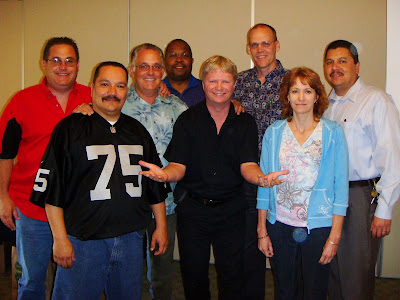
My new friends from CDCR
(California Department of Corrections and Rehabilitation)
Dale, Eddie, Dennis, Ken, me, Todd, Cindy, Ralph

Now it's time to commit to the material. We have to stand up and deliver 20 minutes of content. My section covers Practice 2: Inspire a Shared Vision.
Teach-backs are my favorite part of facilitator training. It's very rewarding to watch a number of people provide a new 'window' into the material.
Often, when they start, I think, "I would never do it this way. What are they thinking?" By the time they finish, however, I'm thinking, "Wow! I'm going to do it this way."

Today was no exception. All the presenters (and this isn't always the case) were authentic and consistent with the material. As I result, I found some great ideas for delivering the material myself.
My section went well. I tried an exercise from the book that I'd never seen before. I wanted to see how it played out live. It turned out very well, so I'll use it with my first session.

It's great getting a safe environment to experiment in.

Friday, June 27th

Apparently, one of us is "Leadership Allen".
This photo is with Mark Springer. Mark heads up a company in Montana that does disaster recovery.

I've spent quite a bit of time with Mark over the past few days, and learned a lot from from his curiosity, energy, and intensity. We've made plans to spend some time with Mark to share some of our practices and tap into his expertise in crisis management.

I don't want to downplay our standard business 'crisis', because any business decision in our company effects 6,000 employees directly and countless others indirectly - but talking to Mark about the work behind disaster recovery puts our problems into perspective, which is always a good thing.

Today, we did 'speed-leads' - 3 to 5 minutes teach-backs of the material - with video cameras running. Again it was a lot of fun. So many great presentations.

I have to comment on Todd's presentation. Todd is one of my new corrections friends. He started his presentation by falling on the ground and proclaiming, "Everytime I fall down, I'm 6 feet 4 inches closer to success." True words demonstrated with conviction.

I'm still digesting all that I took in over these four days.
By all, I mean the material, the Somona Valley, the wine, the food, the time with Ken and Brent, the new friendships, the experience of watching others present, and the ambiance that you only get in a room full of facilitators who believe in the material.

That's a lot... I'm sure I'll have many comments in days to come.


Saturday, June 21, 2008

Learning at the Speed of Sound

I'm going to have plenty of learning opportunities over the foreseeable future.

Today, Angie and I are packing for a drive up to Sonoma - wine country.
I'm meeting two colleagues there for a 4 day training workshop.
We're getting certified in The Leadership Challenge.
I'll open another post on that...

Secondly, on July 1st, I start my pursuit of a Master of Arts in Adult Education and Learning from University of Phoenix.
I enjoy the learning world and want spend more time with folks outside my company and industry.
This program is perfect for me, because the online aspect supports my travel schedule.

My objectives from the program are:

  1. Strengthen my knowledge of education theory
  2. Strengthen my skill in instructional design and delivery
  3. Immerse myself in an online learning experience to learn more about my own learning preferences.
  4. Observe the online learning experience for more ideas on how to use it in my workplace.
  5. Network and learn from folks outside my workspace...
I'll be posting through it all!


Thursday, July 6, 2006

The Gift that Keeps on Giving (from Malacca)

Today Angie, Martin and I visited Malacca - a beautiful city in Malaysia.
Malacca has much to offer - the Dutch area, the seashore, and a very cool Chinatown.

My favorite part of town, however, is Kampung (Malay for village) Mortem.
I first visited Kampung Mortem ten years ago and was a little worried that it might not still exist.

Fortunately, though it's getting pressured by high rises, this little gem of a neighborhood is still standing. It's a 4 or 5 street area packed with traditional Malay stilt houses (like above) and friendly people. We wandered the area awhile and enjoyed the cool breezes off the river.

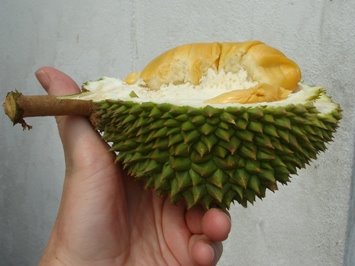
Another 'event' in our day, was a ritual tasting of the legendary 'king of fruits' - durian.
Durian has the texture of custard, is extremely popular in South East Asia, and smells like an open sewer.

One author said, "It's like eating your favorite ice cream while sitting on a toilet".

For me, it's like eating your LEAST favorite ice cream while standing in a PUBLIC toilet - but to each his own.

Is it just a coincidence that we bought it next to the men's toilet at a gas station off the highway? I think not...

The worst feature of durian (unless you like it) is that you will continue to burp up the 'flavor' for the remainder of the day. If you can imagine a mealy fruit that has aftertastes of garlic and onion, you can imagine how pleasant this might be...

It's only real value for me, is as a spiky prop that can used in Jackie Chan films.

We enjoyed the rest of our day - a nice lunch in Chinatown, poking around in a rubber tree plantation (rubber comes from trees. How weird is that?), checking out the biggest bananas we're ever seen, and driving through palm oil groves.

Tomorrow, the teaching begins.
We're teaching Leadership Challenge... but the biggest challenge we'll see this week is the durian...


Tuesday, May 23, 2006

Weaving a Web of Teamwork

During my recent trip to Taiwan, Martin and I conducted the Leadership Challenge Workshop with the management team.

We had some excellent constructive debate in the room.
Everyone shared personal stories and visions, while challenging themselves to shape those experiences into practical work applications.

Along with the workbook activities, there were some team activities that help us build openness, and a sense of fun.
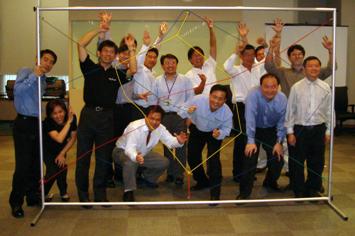
My personal favorite has to be the Spider Web game.

While we use this activity quite often, it's always a kick to watch it with a new group.
If you ever look for an activity to build into a session - try this one!