Showing posts with label workshop. Show all posts

Wednesday, January 27, 2010

Le Grand Tour D'Asia: Day 20 of 58

Geetha, Jaishree, and Uthra

January 27th, 2010
Learning Moment: Chennai, India

Today was a relatively quiet day.

It was cloudy during my commute into work; the first cloudy day we've seen. I continued reading "You Must Be Joking, Mr. Feynman" during the ride. Just as we reached the office, rain began to fall. Everyone seemed surprised, as the rainy season isn't due to start for another month. It was a short rainfall. The rest of the day was pleasant.

Our second day of the "Managing at KT" workshop was engaging. The group asks many interesting questions. We spent a fair amount of time on SMART goals. Most people don't realize the power of well-written goals, but these folks understood. It's rewarding to see them create strong goals.

Members of our stellar Human Resources team - Geetha, Jaishree, and Uthra - stopped in to make sure all was going well, so I took the opportunity to pose them for a picture.


Thursday, January 21, 2010

Le Grand Tour D'Asia: Day 14 of 58

Winners of the Paper Tower Contest

Thursday, January 21st
Learning Moment: India

I love leading workshops in India.
The attendees are energetic, reflective, and curious.
They fully invest in whatever the topic is. That is such a pleasure.
I learn as much from them as I 'teach' in any session.

Yesterday, we conducted a "Five Dysfunctions of a Team" workshop. As part of the workshop, we did the 'Personal Histories' exercise, where team members share the most difficult time of their childhood and their greatest influence other than their parents.
I felt honored to be able to hear their stories.

I've known most of the participants for four or five years, but I had no idea what many of them had gone through, how hard their parents and other family members worked for them to educated, or how thankful they are for where they are today. It was truly remarkable how many of them could point to one person in their lives and say "I owe everything to that person".

In a world as challenging as the one they grew up in, it is often the prodding of one interested party that makes all the difference. I couldn't help but think about those who prodded me. I also couldn't help but hope that one day I can do the same for another.


Wednesday, January 13, 2010

Le Grand Tour D'Asia: Day 6 of 58

Storyboards Rock...

Wednesday, January 13th
Learning Moment: Singapore


I'm working with Ed Muzio (co-author of Four Secrets to Liking Your Work) on the instructional design of a workshop that will accompany his new book, tentatively titled "Make Work Great!".

I first used storyboarding while working on the slide:ology workshop, but that was done on my office wall. This project marks the first time that I have storyboarded a workshop in my notebook and then worked on it while traveling.

Ed and I brainstormed ideas for the workshop over the course of a couple of months. On my flight to Singapore, I sketched those ideas onto post-it notes with a sharpie and placed them into my notebook. Then, I went through the draft of Ed's book and created more post-its (this second round of notes is in blue pen). Finally, I combined the two sets of notes, moving them into a working order.

You can see that module headers are pink, learning content is yellow, and exercises are blue. At a glance, I can see what the mix of content to exercise is. I've been working on this project by the pool at the Intercontinental Hotel, in our room, at breakfast, and in taxis to the office.

Only now am I constructing the workbook for the course. This storyboarding has made it very easy for me to think visually and see the book before I construct it.


Sunday, July 26, 2009

Thinking Strategically

Our learning team with author Steven Stowell (2nd from right)

The phrase 'strategic thinking' is one of the more dangerous phrases in the business lexicon.

Everyone says it.
Everyone agrees it's important.
Everyone nods a lot when discussing it.

Unfortunately, I'm pretty sure that no one has the same definition in mind...

I'd suggest that strategic thinking belongs with 'pornography' in the "I don't know how to define it, but I know it when I see it" Hall-of-Fame.

Because of this, I was pleased to see that Steven Stowell had a book called "Ahead of the Curve: A Guide to Applied Strategic Thinking". Steve co-wrote two of my favorite coaching books - "The Coach" and "Win/Win Partnerships", so I felt pretty confident that Ahead of the Curve would have some great insights.

I wasn't wrong. Ahead of the Curve addresses strategic thinking - with a little 's' - for everyone. In Steve's mind, a decision about buying a house or choosing a college is a strategic decision - so everyone should have some strategic thinking skills.

It's a great point, and a really good book.

We brought Steve in last week to lead a workshop for us, and then we received certification to teach the course. The workshop was fast, practical, and interesting. The attendees learned a lot.

Steve is an excellent facilitator, and a truly generous soul - with both his time and his knowledge. If you're looking for a course on everyday strategy, I would recommend checking out Steve and his company CMOE.


Wednesday, March 18, 2009

Fun with Acronyms

This morning, I created an acronym - MoVVeRR - for what I'm calling the "Team MoVVeRR" workshop.

  • M - Mission
  • V - Vision
  • V - Values
  • R - Roles
  • R - Responsibilities

It's almost impossible to have an effective team without clarity on in all five of these areas, which makes this one of our most important workshops.

I have to admit, I'm a sucker for a good acronym. This isn't one of my best, but it works...
That's good enough for me!


Monday, February 9, 2009

Preparation and Teamwork...

On Friday, Brent and I led a team building workshop with about 25 participants. It was a typical agenda for this type of event - Photo Facilitation for an icebreaker, Patrick Lencioni's 5 Dysfunctions of a team video and survey, followed by DiSC profiling. Things were going great, until the power went out in the middle of the 5 Dysfuctions Video.


I always preach that one should never have a presentation that they couldn't nail with the power out. The idea is that you never know what will happen. Most of the time it isn't a power outage. It could be a room without a projector, a chance meeting in a restaurant, or just a change of schedule. The point is - be ready.

We quickly changed the schedule and had the team work on their DiSC profiles while we waited for power.
It came up rather quickly. We then had the issue of getting the system to work again
While I took the team through a 'chalk talk' about and got things going - turning on the projector with the correct slide, right in sync with my discussion. 
We even got a round of applause from a pretty tough crowd.

Two Lessons to take away from this event:
  • Preparation: Always be ready. We could have delivered the whole session without power. I had handouts of the models and am able to give a 'chalk talk' with no slides. We had all our materials and could have taken the team outdoors.
  • Teamwork: For key jobs, always have a partner. This workshop was for a key client, so I just offhandedly invited Brent the day before. Man, am I glad I did that! Be able to do it yourself, but always try to get backup support.


Tuesday, November 11, 2008

Using the Parking Lot as a Facilitation Tool


Some things seem too obvious to discuss... but they're not...

I've been working on a training class for facilitation.
One common tool of facilitation is the 'parking lot'.
I took it out of the class, because I thought it was too obvious.
Recently, however, I found that many experienced facilitators have never heard of a parking lot.
Now it's back in my class.

A parking lot is a place where the group can track ideas or questions that are currently off-topic.
It's usually written on a flip chart, a corner of a white board, or a piece of paper.

It's a good idea to set this up at the beginning of a session with a few words, "I don't want to let us get off topic. At the the same time, I want to capture any great ideas we have. So, let's talk freely. If I think something is off-topic, however, or better handled later, I'll put it in the parking lot. Okay?"

This accomplishes a number of objectives.
  1. it keeps us on topic
  2. it helps us capture great ideas
  3. it helps the facilitator look competent
So, next time you have a meeting or workshop, try using a parking lot!


Saturday, October 11, 2008

Situational Leadership II: Diagnosing Your Development Level

I'm a D4 at Fake Surfing

I led a Situational Leadership II (SLII) workshop last week.
I always enjoy being present for the 'aha' moment that the attendees experience.
In fact, that's my fuel. I love facilitating an experience that is designed to trigger an 'a-ha' moment and then watching it happen.
But that's a post for another day.

Today, I want to discuss SLII - more specifically, I want to discuss Development Levels.
If I had known about this development model when I first started working (or even sooner), my life could have been a lot more productive.

The SLII model proposes that there are four development levels a person goes through when they learn a new goal, task or skill. The levels are defined by the amount of competence and commitment possessed by the person executing the task.

Wherever I have taught SLII - from India to Israel to Singapore to Japan to yes, even Texas - most people have learned to ride a bike. So, I use this as my example.

Growing up in my home, we were most likely to get our first bike as a Christmas present. We'd ask for a bike and our parents would say, "Maybe if you're good all year, Santa will bring you a bike for Christmas..."
So, we'd try to behave all year (and try to hide it when we didn't...) while looking forward to Christmas.
  • D1 - On Christmas morning, I woke up and ran down the stairs to find a big (bicycle-size) box under the tree, with my name on it. I didn't want to eat breakfast. I ran upstairs and woke everyone up. I couldn't wait to get that box open. Though I had no idea how to ride a bike - I desperately wanted to ride it. My commitment was high. My competence was low. In the SLII model, I'm described as an Enthusiastic Beginner.
  • D2 - I opened the box. I didn't care about my other presents or about seeing my siblings open their presents... I wanted to ride! You can probably guess what happened next.
    We got the bike assembled. I took it outside. I got on it.
    I headed down the driveway....
    And....
    Yep, I fell. I fell pretty hard, actually.
    Suddenly, my commitment fell to a lower level. I wasn't so keen to get back on the bike.
    Simultaneously, my competence had gone up a little. I didn't know it, but I had learned a few things about gravity, balance, brakes, and the sting of gravel.
    In the SLII model, I'm now described as a Disillusioned Learner.
    The bloom was off the proverbial rose.
  • D3 - By spring, if you'd passed by the Hughes household, you'd have seen me riding in circles around the driveway. I could turn left, turn right, shift gears, stop. I could even pull a few 'wheelies'. I was enjoying myself. This was fun! My competence was quite high.
    You wouldn't have seen me leave the driveway, however. Riding in the road intimidated me. It didn't sound fun. In the driveway, sure, but not in the road. My commitment was variable.
    In the SLII model, I was a Capable, but Cautious Performer.
  • D4 - By the summer, I was riding everywhere. In fact, my parents threatened to take my bike away a few times. I was having too much fun. Anyway, my competence was high and my commitment was high.
    I had reached the High Achiever stage.

This development model repeats throughout our life.

It doesn't matter if its going to college, becoming a parent, learning a language or sport, starting in your first job, or having sex for the first time (this is actually the best example - think about it). The pattern is predictable.
  • D1 - You're excited to go try this new great thing. You've imagined how great it will be. What could go wrong?
  • D2 - It's harder than you think. You're uncomfortable or embarrassed. You fail an early test of competence.
  • D3 - You've adjusted your expectations and worked through the difficulties. You can do it now, but you're a little hesitant. You stick to the skills you know and don't take chances. You don't raise your hand and volunteer for new opportunities or difficult assignments.
  • D4 - With perseverance, and hopefully a little help, you become confident. People now come to you for help. You make your own decisions or even take lead.

So, why is this model important?
We all have the same goal - we want to get from D1 to D4 as quickly and painlessly as possible.

But a D2 at Real Surfing...

Knowing the model will help us do that. Realizing that D2 is a normal stage that most people go through on most tasks is reassuring. It allows us to seek help.

Here's your homework - List three tasks, goals, or skills you're working on.
Pick a discrete task that be written as a procedure - not "I want to be an engineer" or "I'm managing a project".
Being an engineer or managing a project requires many tasks or skills, so pick a few of those - like 'learning boolean algebra' or 'creating a schedule for the project'.

Once you've written your tasks, diagnose your development level.
Is your competence high, medium, or low?
Is your commitment high, medium, or low?

Next week, I'll talk about getting the help you need (or giving the help someone else needs) to progress through the development model.


Friday, October 10, 2008

A Workbook for Learning About Culture

I lived in Asia for over 10 years, so I know how challenging an expat assignment can be.
In this global economy, the odds are higher than ever that you will work overseas, or that the person next to you is currently working overseas.

For those of you who are going, are thinking about going, or just spend so much time overseas that you feel like you live there - here is an excellent resource.

The Peace Corps probably has as much experience at sending people overseas as any organization on earth. So, it makes sense that they would have some tools for preparing people to work with other cultures.

Here is the 266 page workbook that the Peace Corps uses.
And it's a FREE DOWNLOAD!!


It's called Culture Matters.

It covers just about everything you would ever want to know about culture. I cover many of these same points in my "CultureCoach" workshops.

If you are going on an assignment of more than 6 months, I would highly recommend completing the book. If you bring a family, do it together.


Tuesday, September 30, 2008

Identifying Your Training Weaknesses

I'm a book geek. One of the few things I like better than a bookstore is a used bookstore.
Petaluma, California has a very good one called Copperfields, where Angie and I spent a couple hours yesterday.

I bought a mint copy of "101 Stupid Things Trainers Do to Sabotage Success" there and leafed through it last night.
The book serves as an excellent reminder of how many things can go wrong in a training situation.

My pet peeve is #64 - Foolish Icebreakers. I hate icebreakers. If a class is properly designed, the introduction of attendees should happen organically. If you want me to do a formal introduction, fine... but don't ask me to pick which animal is most like me. Just ask me to introduce myself. Better yet, give us a topic-relevant exercise that requires us to meet each other.

Two that I could be better at would be #41 - using inappropriate humor - occasionally my filter doesn't work quickly enough, and #86 - flopping flip charts. I'm a frequent user of flip charts, but this book reminded me that once you flip the page, people can't see what you wrote. The book suggests hanging the important sheets (and they're all important, or you wouldn't be writing them, right?) so the group can refer back to them.
Great suggestion, and a good book.

What are your biggest training weaknesses?


Wednesday, September 3, 2008

offerings@huesworks

Glenn delivers the learning profession's most highly regarded programs - such as Situational Leadership II®, The Leadership Challenge® Workshop, and Six Thinking Hats® - around the world.

The offerings in Glenn's toolbox can be mixed and combined to create comprehensive programs.


SMART as Hell!

SMART as Hell teaches individuals how to take control of their own success in work and life. Anyone who writes goals or is asked to meet goals needs this workshop.

Sessions include:

  • A step-by-step process for writing goals that are SMART as Hell!
  • The SMARTometer - the worlds first tool to measure how SMART a goal is.
  • Case studies from a variety of organizations including businesses, the military, the public sector, and even the Obama campaign.


CultureCoach

Today, business challenges are often synonomous with cultural challenges.
  • Worried about your first business trip to Asia?
  • Getting ready to live overeseas?
  • Having problems with business cross-culturally?
  • Need assistance getting the most out of your global team?

These are just a few of the scenarios that Glenn coaches his clients through. Whether it's a single session to prepare for a meeting tomorrow, or extended coaching for working cross-culturally - Glenn will help you get results.

CultureCoach is also available as a workshop for cross-cultural teams.

Glenn is a graduate of Coach U and a member of the International Association of Coaching.


DiSC Profiling

Ever wonder why your boss, your employees, your peers, or your customers behave the way they do? Ever wonder what you can do to help them accomplish their goals?

DiSC is a model that shows you how to understand normal human behavior - for yourself and others.

With this tool, Glenn helps you build work relationships, customer satisfaction, and stronger team dynamics.


Edward de Bono's The Six Thinking Hats®

Productive group thinking is a rare thing. Conflict or debate are more common, and rarely produce optimal results.

Glenn is a certified instructor of Edward de Bono's Six Thinking Hats® - a simple, effective parallel thinking process that helps people be more productive, focused, and mindfully involved. Six Thinking Hats® yields stronger ideas in less time.


Global Presentation Skills

Some people will tell you that there are no shorcuts in life.
They're wrong.
Poor presentation skills will destroy the best plans, and strong presentation skills will give you an advantage over your peers.

If you want to create change, you'll need to communicate that change and communicate it globally.

This workshop - built around the premise that people want 'conversations, not presentations' - will provide you with the tools to communicate your message in a format that will be successful around the world.


High Performance Teams

Have you ever enjoyed the 'buzz' of being on a great team?
Glenn relishes the challenge of facilitating a team to the next level, and utilizes his wide range of experiences in team environments.
  • Sports - coaching baseball, playing football, hockey and volleyball
  • Water Expeditions - In Baja Mexico and Utah's Green River
  • The Asia workplace - Which has a special perspective on what 'team' means
  • Corporate Management - building and coaching teams

In customized High Performance Teams sessions, Glenn guides teams through a discovery and identification process and then facilitates the team to create an actionable roadmap for championship performance.


Innovation Workshop

Looking for a spark?
Creativity is not magic. It is a game with clear rules. Unfortunately, most organizations don't know those rules. Even when they do, they're unlikely to follow them.

Glenn often is called on to create an environment where even the most 'uncreative' team can produce new, business-ready ideas.

As someone who has designed dozens of released offerings and must be ready to improvise in any setting, Glenn is uniquely suited to help teams produce innovative results. Glenn also exercises his creativity through music and photography - some of which appears on this site.


Managing & Leading Globally

There are only two types of management skills - navigational skills and survival skills.

When you don't have navigational skills, you need to develop survival skills. When you have great navigational skills, you may not have developed survival skills for when they're needed. To be a flexible leader, you must first have both of these skills

Glenn works with individuals to develop the navigation and survival skills necessary to be a great manager. Then, Glenn guides them through the self-reflection necessary to be a great leader.


The Leadership Challenge® Workshop

Approaching leadership as a measurable, learnable, and teachable set of behaviors, this proven leadership model proclaims Leadership Is Everyone’s Business.

The workshop, combined with the Leadership Practices Inventory - a validated 360-degree tool - provides the framework to become a better leader.

Glenn is a Level I Facilitator of The Leadership Challenge® Workshop.


Maximizing Customer Relationships

How strong is the link between you and your customers?

Maximizing Customer Relationships shows that 'caring' is not a soft skill - but rather a tangible component of the service experience. In the workshop attendees see how 'care' can be measured and delivered to customers - providing greater returns for everyone.


Problem Solving the 7-Step Way


Problem solving is the most fundamental of business skills, but many of us are poor at it. A review of most problem solving efforts will show that they take more time, money, effort, and rework than was necessary.

Root cause analysis is the most effective method for permanently solving problems.

Glenn leads teams and individuals through a 1-day workshop, with a case study, to learn the 7-step methodology. He also provides coaching and facilitation to assist in reinforcing the skills.


Situational Leadership II® Workshop

Ken Blanchard Companies' Situational Leadership II® is the most comprehensive method of managing and developing people in the world.

Glenn is a certified instructor for this 2-day session.

More importantly, he is a passionate user of the model - with his clients,
students, employees, and himself.

Glenn can be reached at glenn_hughes@hotmail.com.


Monday, August 4, 2008

What are the Six Thinking Hats?

Today marked the start of our summer workshops for the learning center and human resource departments.

I've organized two weeks of teaching new tools and practicing old ones. We kicked off today with Six Thinking Hats.

If you're not familiar with this thinking framework, you should check it out immediately. I never get tired of singing its' praises.

Here's a google search for 'six thinking hats pdf'. This will give you plenty of info to choose from. Or you can order Edward de Bono's book from Amazon.

The class is excellent. I enjoy putting strong tools into the hands of people who need them.

We had a good session today, with a lot of practice exercises. I'm looking forward to seeing it rolled out. It's amazing to see the shift from an exercise done without the Six Thinking Hats, to one done with them.

The basic concept is that debate results in an 'arm-wrestling' mentality that reduces any possibility of finding the best answer through synthesis. Any election shows how true this proposition is.

Instead, Six Thinking Hats proposes that we work through the six types of thinking together. The six types are:

  • Blue/Process, 
  • White/Information, 
  • Red/Emotion, 
  • Yellow/Positive, 
  • Red/Negative, 
  • Green/Creative
This way, we can leverage the intelligence of all participants. Sounds a little Utopian, I know, but it works!

If you think your group would benefit from reduced debate, better ideas, and more engaged participation, then take a look at Six Thinking Hats.


Tuesday, July 15, 2008

What Are You Working On?

I was helping a team that had 'prioritization' problems, so we did this exercise.

I asked the team to write down (on Post-it Notes) the tasks that they do in a typical week.
We made four columns - Mission Related, Strategic Objective Related, Personal Objective Related, and Other - and two rows - Proactive and Reactive.
I then asked them to place the tasks in the appropriate box. What did we discover?
  1. The team agreed that they didn't really know what the mission was. Hard to prioritize if you don't know that...
  2. A lot of 'other' activities are being done. Are they mission related? Who knows?
  3. More than 40% of the work was reactive (non-scheduled). The team agreed that this was too high.

Action items the team agreed on:

  • Write the mission.
  • Regroup the tasks, if necessary, against the mission.
  • Review the 'other' tasks. Distribute them to other groups? Stop doing them?
  • Look at reorganizing the team, the roles, or the schedules to address the number of reactive/non-scheduled tasks.

Having time-management challenges on your team? This might be a good exercise...


Thursday, June 12, 2008

Egonomics


Today, Sharon and I were leading a group through the Egonomics workshop.
If you haven't read Egonomics, I highly recommend it.

I'm a big believer in using language to re-center a discussion.
Marcum and Smith do this very effective in Egonomics, first by discussing humilty as a midpoint between egotistical and ego-empty - rather than as the opposite of ego.

Secondly, I love their distinction that the overuse of a strength is NOT a weakness, but rather a counterfeit. It feels and looks a lot like the original, but produces a lesser outcome.

The workshop never fails to produce an 'a-ha' moment in both the audience and the facilitators.
Check out their website, there's some good downloads there.


Tuesday, May 23, 2006

Weaving a Web of Teamwork

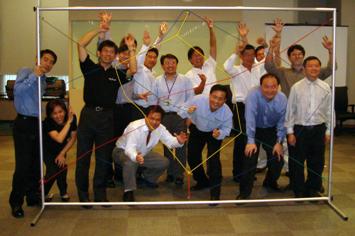
During my recent trip to Taiwan, Martin and I conducted the Leadership Challenge Workshop with the management team.

We had some excellent constructive debate in the room.
Everyone shared personal stories and visions, while challenging themselves to shape those experiences into practical work applications.

Along with the workbook activities, there were some team activities that help us build openness, and a sense of fun.
My personal favorite has to be the Spider Web game.

While we use this activity quite often, it's always a kick to watch it with a new group.
If you ever look for an activity to build into a session - try this one!