Showing posts with label facilitation. Show all posts

Saturday, September 12, 2009

Facilitator's Toolbox Update

I was discussing facilitation tools with Tracy Barba of Duarte Design a few weeks ago.

As we talked about some of the difficulties of meeting facilitation, I shared a couple of my favorite tools.

I then realized that I haven't updated the huesworks toolbox in awhile, so here you go!
The updates include:
  • Five Finger Facilitation
  • The Facilitation Diamond
  • Storyboarding
  • ADKAR

Enjoy!


Tuesday, June 9, 2009

10 Tips for Tele-Training


Over the past few weeks, I've successfully conducted a number of Tele-training courses with clients in Asia.
I was skeptical regarding phone delivery, but the clients love it, and I have to admit that they're learning the material just as well as my classroom students do.

I want to share some of the process I've used and capture best practices for your use.

What is Tele-training?

Tele-training is training that occurs over the telephone.
There are no other technologies in usage during Tele-training (no live video, no web browsers, no computers, no transmitted slides).
Slides or documents are used/driven at the receiving end of the training, if needed.

Why Tele-training? Because it:

  • Eliminates travel costs
  • Accelerates delivery cycle-time (no waiting for an instructor to fly)
  • Makes training available to all (working at home, from an airport, or a remote office, for example)
  • Enables economies of scale across offices or regions
  • Attracts more diverse training audiences across offices or regions
  • Reduces or eliminates technical barriers (such as slow video connections, software incompatibilities, passwords, etc)
  • Can reduce classroom time, as homework is assigned for offline completion
  • Is less expensive for the client
  • Simulates the actual work environment, since much of global work today is done by telephone

What Tele-training has been conducted?

I've used Tele-training for a number of audiences and courses, such as:

  • Coaching skills for Service Managers across the US.
  • DiSC Behavior Profiling for Korean Sales and Service Managers.
  • Global Culture Training for a engineering group in Singapore
  • Employee Development Training for HR Business Partners in Asia.

Is Tele-training just Instructor-led training over the phone?

No.
For Tele-training to be successful, the course must undergo some level of redesign.
This redesign may be minor, or it may be extreme.
One of the above courses, for example, was redesigned from an 8-hour instructor-led course, to a 4-hour Tele-training.
The tele-training is now conducted as two 2-hour sessions, with pre-work and home-work between the two sessions.
This allows the content to be delivered in half the classroom time.
Additionally, the materials were redesigned as an interactive, visual workbook.

This new workbook is easier to read and far more engaging.
It also eliminates the need for a PowerPoint slide deck, as the visuals are integrated into the workbook.

What are the Best-Known Methods for Tele-training

I'm continuing to learn, as I conduct more sessions, but here are the lessons thus far.

  1. The course must be reviewed and redesigned for Tele-training. Do not attempt to deliver an instructor-led course by phone without customization.
  2. The learning and performance objectives must be very, very clear.
  3. The course should be exercise-based. Tele-training is not a format for lectures.
  4. Pre-work and homework must be completed. If not, the objectives will not be met.
  5. Sessions should be limited to 2 hours, unless there is significant co-facilitation on the receiving end.
  6. For a two-session course, there should be 48 hours between sessions (example: Tues & Thursday). Shorter periods will not allow time for homework. Longer periods limit retention.
  7. In most cases, classroom sizes should be limited to 8, to provide adequate participation.
  8. A champion/facilitator should be on the receiving end of the course. In each successful session to date, there has been a champion on the receiving end of the training who has helped facilitate materials and discussion.In all cases, the facilitator has been familiar with the me and my methodologies. This makes the process seamless for the participants.
  9. Materials should be engaging and clear. The instructor is not be in a position to entertain learners nor to explain ambiguous materials. Tele-training will test the clarity of your materials.
  10. I keep a list of all attendees and specifically call on individuals for Q&A. This ensures involvement, engagement, and evaluation.

My goal for next year is to conduct at least 3 workshops a month by tele-training.
I'm currently reviewing all of my courses to see how I can adapt them for this mode of delivery. Planning the participants pre-work and homework assignements is key making the program work.

What are you experiences (as a facilitator or student) with tele-training?


Wednesday, March 11, 2009

VizThink 09 Highlights VII: John Wards' Kinesthetic Modeling

John Ward leading our workshop

I saw some outstanding talks at VizThink 09, and met some really interesting people - but the greatest takeaway from the three days was definitely my introduction to Kinesthetic Modeling.

The workshop was led by John Ward of Many Minds. John is one of the nicest men you'll ever meet. I'd been introduced to John last year, when he was doing the graphic recording of the Leadership Challenge event I attended in Sonoma, so I was happy to see him again.

I knew that John was on the agenda at VizThink, but apologized to him - I wouldn't be able to attend his workshop, because I needed to see another one.
John, gentleman that he is, scheduled a follow-up session for myself and a number of others who also expressed disappointment at missing his session.

So, Tuesday night we all gathered to learn about Kinesthetic Modeling.

I am a camera...

John issued each table of 4 a bag of 'holy scrap' - odds and ends that possess no inherent meaning - and asked us to dump the bag on the table. Then he walked us through a quick process:
  1. Each of us were to grab 3-4 pieces that 'spoke to us'.
  2. Organize the pieces in a manner that said something about us
  3. Let the other members of our table tell us what they see.
  4. Share what we saw and meant to convey.

My arrangement is displayed above. My tablemates saw a swimming pool with aliens.
I saw a collection of technical hardware (I'm an engineer), that were very toy-like (I still love to play), and I arranged them into a camera (my favorite toy, tool, and mode of expression).

That was interesting, but the big project was yet to come:
Our team project called for us to model the current economic situation and its impact on the visual thinking community. To say we were skeptical would be an understatement.

The four of us modeled in silence. It was really bizarre to model and utilize resources with no conversation. I had no idea what my colleagues were making, so just did my own thing and tried to stay out of their way.

After about 15 minutes, John asked us to stop.
We were left with what you see below.

The current economic situation and its impact on the visual thinking community

John asked us to walk around the table, commenting on items we didn't construct, and write down what we saw in those objects. After we did that, the people who constructed them told us their intention. We were aligned on many items, but very different on others.

Our next step was to create meaning from all the observations, and capture our key thoughts.

Our thoughts...

You'll see that our thoughts were quite profound for such a quick activity:
  • Our beacon (the spoon) is surrounded by barriers.
  • The community is outside the wall.
  • Shelters from the storm look frighteningly similar to traps.
  • Walls had been built through fear, but they are keeping the community from the 'gold'.

I don't think I've ever seen an activity bring that much alignment on a complex issue so quickly.
I'll be trying this one with my internal teams in the near future.

I would highly recommend that you attend one of John's workshops and see this methodology for yourself. It's very powerful.


Saturday, March 7, 2009

Facilitating with Card Decks

If you've missed it, Dave Gray (of XPLANE) and I have been having a dialog in the comments section of my XPLANE Discovery cards post. The conversation has rotated around facilitation card decks like the Discovery cards, IDEO's method cards, Roger von Oech's Creativity cards, etc...


Dave made an interesting comment that he thinks these card decks derive their inspiration, "not from playing cards, like Pokemon, Tarot and the good old Bicycle deck, but rather from recipe cards. Each card is essentially a recipe, to be pulled from the deck when it can be useful and executed".

I think he's on to something, but I would suggest there's more to it than that.
I rarely think without a pen in my hand (the running joke at work is to hide the white board markers if you want to shut me up... but it doesn't work!), so I put together the above diagram of Facilitation tools.
The diagram includes the card decks I use most often, plus kinesthetic modeling (building models with clay, etc) and photo facilitation (using imagery to stimulate thought and conversation).

As you can see, this conceptual model has 2 axis, with 4 points.
  1. One continuum spans from tools that are Mysterious/Provoking at one end, to tools that are Clear/Reminding at the other end. Oracles at the top, Plain English at the bottom.
  2. The other continuum spans from Directing (the tools are pushing ideas and stories at you) to Listening (the tools are pulling ideas and stories from you)

Based on these continuum, there are four types of tools:
  • Recipe Cards - I love this analogy from Dave, and it fits the model. These cards are clear. They might be reminding you of possibilities that you already knew. They are directive, with some level of instruction. Recipes shouldn't be mysterious and - typically - aren't meant to be inspiring. They might inspire you, but that's a result of how you use them - not a design of the recipe (unless your recipe cards are fragmented and you can mix and match - but then it's not really a recipe). Everyone who uses a recipe should get a similar process.
    I would put the IDEO, ThinkPak, and 36 Stratagems cards here.
  • Externalization Engines - These are tools that are meant to pull stories and ideas out of you. But they're clear. They are not meant to require deep interpretation. These are often cards that are sorted into 'yes/no', 'hit/miss', 'good/bad/neutral' piles.
    The Leadership Challenge Values Cards are a perfect example. They are a set of cards with values listed on them. The user does a quick sort to identify and prioritize their values and then discuss them. It's what I call an externalization engine.
    I would put the XPLANE Discovery cards here as well. They are used in a sort, they pull stories and thoughts from the user, and they are very clear. The cards do provide some direction, so I push them closer to the center of the grid.
  • Muse Devices - These are also intended to pull stories and ideas from the user, but these are NOT clear. Everyone will have a different interpretation. These are, basically, oracle devices.
    I place Kinesthetic Modeling here, along with Oblique Strategies (thanks Dave! I ordered two sets. I also see there's an iPhone application for them) and my Tao Te Ching cards.
    Photo Facilitation sits in the middle of Muse and Externalization, because the images are concrete (clear) but can be interpreted differently (provoking).
  • Mentoring Devices - First, I'm not in love with the label 'Mentoring', but I'll live with it for today. Mentoring devices are directive, but not necessarily clear. They are for people who need a push towards possibilities, not old methods.
    Roger von Oech's card decks fit here. A line like "Ask a fool - to dislodge assumptions", is directive, but counter-intuitive to some, and begs the interpretation of a 'fool'.

Why did I spend the past two hours building this model? That's what my wife just asked me when I tried to convince her that it was really interesting...

Well, as a facilitator with a box full of tools, I like to have a framework that helps me decide when to use a particular tool.
Second, a framework like this helps me decide if I have full coverage from the tools in my kit (it looks like I do).
Finally, this framework helps me work with others - both my peers, and more importantly, my clients. Discussing this model with a client would allow me to decide which tool is appropriate and obtain their buy-in.

Well, it's a new model, so feel free to kick the tires and rip it apart. 
What tools am I missing? 
Is there a better way to draw it?
Disagree with my labels?

Let me know...


Tuesday, January 27, 2009

Warming Up with Images

I did some more work with metaphorical images today.

The group is starting some strategic planning, but they don't really know each other that well. They wanted a warm-up exercise that would allow them to get to know each other, but still apply to the topic.

With the images, it's easy.
We simply spread the images and the table and asked them to:

  1. Pick an image that serves as a metaphor for their personality. We then had each member share.
  2. Pick an image that serves as a metaphor for their career. We then shared.
  3. Pick an image that serves as a metaphor for what they hoped to accomplish in this 2-day session.

In 30 minutes, we were able to get some laughs, get to know each other, and hone into the important topic.
That's why I love these images!


Tuesday, December 16, 2008

Five Finger Facilitation

Here's one of my favorite facilitation strategies.

It's called "Five Finger Facilitation".

Trying to reach consensus with a team?
I hang this image on a poster or draw it on a white board.
And ask everyone to raise their hand and show their feelings.

Sometimes, folks are arguing, when they are all above a 3!
So, rather than trying to get everyone to say yes, I just want to get everyone above a 3 (assuming of course, that at least a few are at 4 or 5 - if not, discuss further).

Anyone below a 2 is now approached this this question - "What would it take to get you to live with it?"
That's a lot different question that "Why don't you like it?", or "What would make you change your mind?".

You can continue to float proposals and keep asking for a 'finger check', until you get everyone to three.
Try it!


Tuesday, December 9, 2008

The Facilitation Diamond


If you're at all interested in teamwork, thinking, creativity, decision-making, or facilitation - you should read "Facilitator's Guide to Participatory Decision-Making" and keep it on your shelf for reference.


The book is full of good stuff, but my favorite tool in the book is the Facilitation Diamond.
Everytime I schedule a group facilitation, I have a pre-meeting with the session sponsor.
In the pre-meeting, I draw the Facilitation Diamond on the white board to show how the session will progress.

At this point, I open my toolbox and we decide which tools will work best.
I use seven (or so) sections to the session:
  1. Opening: Go over the agenda. Share the diamond flow. Perhaps a quick exercise.
  2. Diverging Activity 1: Present traditional or evolutionary ideas.
  3. Diverging Activity 2: Stimulate non-tradition, revolutionary ideas.
  4. Transition: A break or a brain-cleansing exercise.
  5. Converging Activity 1: To narrow the multitude of ideas to some actionable ones.
  6. Converging Activity 2: To chose the best one (or 3 - 5 ideas).
  7. Closing: Decide on next actions

I have large posters of the image above that I label with the tools that we'll be using. I hang these as the session agenda. 
It allows everyone to see a map of the energy flow for the day.

Here's a pdf that outlines the method in more detail.


Tuesday, November 25, 2008

How to Run a Process Walkthrough

Last week, I tried something new.


I was working with a group on a logistics process, and it seemed to me that the whole discussion was too cerebral. We had a one-dimensional Visio image on a screen, but no process is one-dimensional.

Any process is 4 parts people, 2 parts machine, 1 part time, 1 part emotion, 3 parts fumbling in the dark, and 1 part flowchart..
That's on a good day.

You probably know by know that I'm a sports nut. So, I reached into my sports metaphor toolbox and suggested we do a 'no-pads' walkthrough.
Let's print out each process box on a 8x10 piece of paper, lay it out on a floor, and - like a giant chess board - literally walkthrough it and see what happens.

So, yesterday we tried it. It was amazing to see the difference. Staring at a projected screen is entirely a left-brain event. As soon as we stepped up and walked around our '3-D swimlane chart', people noticed problems. Right brains become engaged.
Imagine the power of using your whole brain at work... no, really... imagine!!
In 90 minutes, we changed about 60% of the process - simplifying and clarifying it.

I was pretty proud of myself, until Ken informed me that this is a standard event in the world of process mapping. Oh well. It was still pretty cool...
Where would a walk through help your team?


Tuesday, November 18, 2008

Cool Facilitation Toys

It's a dirty secret in the world of facilitation that we're all just kids who want to play.

Anytime facilitators get together, the conversation ends up at questions like, "what games do you use?" or "found any good exercises?".

Here's one for you. Sherryl found this one for me a couple months ago, and we've been using it quite a bit.
It's called a thumball. We got it from Trainers Warehouse.

It's simple and fun. You throw the ball from one person to another. As someone catches it, they look at what segment rests under their right thumb and answer the question like, "where you grew up" or "best fast food". It's a great icebreaker - fast, physical, and low-risk.

Try it!!


Tuesday, November 11, 2008

Using the Parking Lot as a Facilitation Tool


Some things seem too obvious to discuss... but they're not...

I've been working on a training class for facilitation.
One common tool of facilitation is the 'parking lot'.
I took it out of the class, because I thought it was too obvious.
Recently, however, I found that many experienced facilitators have never heard of a parking lot.
Now it's back in my class.

A parking lot is a place where the group can track ideas or questions that are currently off-topic.
It's usually written on a flip chart, a corner of a white board, or a piece of paper.

It's a good idea to set this up at the beginning of a session with a few words, "I don't want to let us get off topic. At the the same time, I want to capture any great ideas we have. So, let's talk freely. If I think something is off-topic, however, or better handled later, I'll put it in the parking lot. Okay?"

This accomplishes a number of objectives.
  1. it keeps us on topic
  2. it helps us capture great ideas
  3. it helps the facilitator look competent
So, next time you have a meeting or workshop, try using a parking lot!


Thursday, October 23, 2008

2009 Visual Thinking Conference in San Jose


Here's the ad for VizThink 09 in San Jose.

Besides being a good advertisement, it creates a useful graphic vocabulary for the disciplines of Visual Thinking.

VizThink takes place in February and I will certainly be there.
I missed last year's event, as I was in India, but this year I'm scheduling around it.

Hopefully, I'll see you there!


Tuesday, September 16, 2008

What is Language Processing?

Today I'm at the Hotel DeAnza Hotel in San Jose facilitating a strategic discussion for one of our divisions, using the Language Processing (LP) method.

Language Processing is a great method for achieving alignment on a problem that's still at the qualitative (vs. quantitative) stage.

LP operates under the assumption that semantics are critical at this point. By addressing those semantic differences, it provides a process that almost guarantees a smooth facilitation.


Here are three ways you can learn more about Language Processing.

  • This article outlines how to do a language processing session. I was surprised to see it called a 'KJ Analysis'. It turns out that it was named after Jiro Kawakita, a Japanese anthropologist.
    As one who fancies himself an amateur anthropologist (you cannot live overseas for 10 years without becoming an amateur anthropologist - as well as an apologist for American policy, but that's another story), I'm unreasonably pleased to discover this methodology was born from anthropology.
  • This short manual by the CQM organization, is the one I carry for my sessions.
  • "A New American TQM" - while looking through a peer's bookshelf, I found this excellent hardcover book by the Center for Quality Management that covers both Language Processing and the 7-Step Problem Solving Methodology.
    The book is out of print, but you can buy it used on Amazon. I ordered it yesterday.

Read the article and try it on your next qualitative problem statement.


Wednesday, September 3, 2008

offerings@huesworks

Glenn delivers the learning profession's most highly regarded programs - such as Situational Leadership II®, The Leadership Challenge® Workshop, and Six Thinking Hats® - around the world.

The offerings in Glenn's toolbox can be mixed and combined to create comprehensive programs.


SMART as Hell!

SMART as Hell teaches individuals how to take control of their own success in work and life. Anyone who writes goals or is asked to meet goals needs this workshop.

Sessions include:

  • A step-by-step process for writing goals that are SMART as Hell!
  • The SMARTometer - the worlds first tool to measure how SMART a goal is.
  • Case studies from a variety of organizations including businesses, the military, the public sector, and even the Obama campaign.


CultureCoach

Today, business challenges are often synonomous with cultural challenges.
  • Worried about your first business trip to Asia?
  • Getting ready to live overeseas?
  • Having problems with business cross-culturally?
  • Need assistance getting the most out of your global team?

These are just a few of the scenarios that Glenn coaches his clients through. Whether it's a single session to prepare for a meeting tomorrow, or extended coaching for working cross-culturally - Glenn will help you get results.

CultureCoach is also available as a workshop for cross-cultural teams.

Glenn is a graduate of Coach U and a member of the International Association of Coaching.


DiSC Profiling

Ever wonder why your boss, your employees, your peers, or your customers behave the way they do? Ever wonder what you can do to help them accomplish their goals?

DiSC is a model that shows you how to understand normal human behavior - for yourself and others.

With this tool, Glenn helps you build work relationships, customer satisfaction, and stronger team dynamics.


Edward de Bono's The Six Thinking Hats®

Productive group thinking is a rare thing. Conflict or debate are more common, and rarely produce optimal results.

Glenn is a certified instructor of Edward de Bono's Six Thinking Hats® - a simple, effective parallel thinking process that helps people be more productive, focused, and mindfully involved. Six Thinking Hats® yields stronger ideas in less time.


Global Presentation Skills

Some people will tell you that there are no shorcuts in life.
They're wrong.
Poor presentation skills will destroy the best plans, and strong presentation skills will give you an advantage over your peers.

If you want to create change, you'll need to communicate that change and communicate it globally.

This workshop - built around the premise that people want 'conversations, not presentations' - will provide you with the tools to communicate your message in a format that will be successful around the world.


High Performance Teams

Have you ever enjoyed the 'buzz' of being on a great team?
Glenn relishes the challenge of facilitating a team to the next level, and utilizes his wide range of experiences in team environments.
  • Sports - coaching baseball, playing football, hockey and volleyball
  • Water Expeditions - In Baja Mexico and Utah's Green River
  • The Asia workplace - Which has a special perspective on what 'team' means
  • Corporate Management - building and coaching teams

In customized High Performance Teams sessions, Glenn guides teams through a discovery and identification process and then facilitates the team to create an actionable roadmap for championship performance.


Innovation Workshop

Looking for a spark?
Creativity is not magic. It is a game with clear rules. Unfortunately, most organizations don't know those rules. Even when they do, they're unlikely to follow them.

Glenn often is called on to create an environment where even the most 'uncreative' team can produce new, business-ready ideas.

As someone who has designed dozens of released offerings and must be ready to improvise in any setting, Glenn is uniquely suited to help teams produce innovative results. Glenn also exercises his creativity through music and photography - some of which appears on this site.


Managing & Leading Globally

There are only two types of management skills - navigational skills and survival skills.

When you don't have navigational skills, you need to develop survival skills. When you have great navigational skills, you may not have developed survival skills for when they're needed. To be a flexible leader, you must first have both of these skills

Glenn works with individuals to develop the navigation and survival skills necessary to be a great manager. Then, Glenn guides them through the self-reflection necessary to be a great leader.


The Leadership Challenge® Workshop

Approaching leadership as a measurable, learnable, and teachable set of behaviors, this proven leadership model proclaims Leadership Is Everyone’s Business.

The workshop, combined with the Leadership Practices Inventory - a validated 360-degree tool - provides the framework to become a better leader.

Glenn is a Level I Facilitator of The Leadership Challenge® Workshop.


Maximizing Customer Relationships

How strong is the link between you and your customers?

Maximizing Customer Relationships shows that 'caring' is not a soft skill - but rather a tangible component of the service experience. In the workshop attendees see how 'care' can be measured and delivered to customers - providing greater returns for everyone.


Problem Solving the 7-Step Way


Problem solving is the most fundamental of business skills, but many of us are poor at it. A review of most problem solving efforts will show that they take more time, money, effort, and rework than was necessary.

Root cause analysis is the most effective method for permanently solving problems.

Glenn leads teams and individuals through a 1-day workshop, with a case study, to learn the 7-step methodology. He also provides coaching and facilitation to assist in reinforcing the skills.


Situational Leadership II® Workshop

Ken Blanchard Companies' Situational Leadership II® is the most comprehensive method of managing and developing people in the world.

Glenn is a certified instructor for this 2-day session.

More importantly, he is a passionate user of the model - with his clients,
students, employees, and himself.

Glenn can be reached at glenn_hughes@hotmail.com.


Tuesday, August 12, 2008

People Need Tools

I've said it before. I'll say it again a thousand times in the next year, I suspect.


People need tools.
Now, I'm an engineer, so I'm sure I have a bias here... but... we are a tool-using species.

Anyway, I love sharing tools with people and seeing them do cool things with these new found toys.

Last week and this week, for example, I'm running a two-week 'summer workshop series' with my training peers and the HR team. We've covered Six Thinking Hats, Language Processing, SMART goals, Vision statements and a bunch more.
Today, we covered Innovation. I shared a number of exercises and activities (TOOLS, I prefer TOOLS!!) from the book Thinkertoys, by Michael Michalko. Great book - go buy it now!

What I loved about the session today was hearing a participant say, "I'm not creative at all", and then, through the use of these tools, come up with one brilliant, cool, innovative idea after another.

And then, with all that output in front of her, insist, "No - really! I'm not creative!".
Well, people aren't creative... output is creative.
So if you end up with creative output, that's good enough for me!


Monday, July 28, 2008

Advanced Leadership Challenge

We're in Sonoma, California this week.
It's a Leadership Challenge Workshop filled with advanced facilitators.
It's a very tough crowd, and that's a good thing. We learn a lot from each other.

As I've challenged myself to write a haiku everyday this week, here's todays.

facilitators
teaching each other content
leadership challenge


Tuesday, July 8, 2008

Visual Thinking - What's Out of Play?


My colleagues and I were working on a team facilitation today. 
In order to frame the discussion, we asked what topics were open for debate, and which ones weren't.

I want to be clear that this wasn't censorship, or an attempt to avoid the 'elephant in the room'.
The 'out of play' topics are basically the 'No Whining' Zone, or the 'Dead Horse' zone - things that are constantly complained about, even though you know you can't change them.

As the group was generating the topics on Post-it Notes, I had the idea to represent the concept as a baseball field with 'fair balls' and 'foul balls'. It worked well, so Brent recreated it in a PowerPoint slide.

You could just as easily use a Football field (in bounds and out of bounds) with an international audience.


Sunday, June 22, 2008

Attending The Leadership Challenge Workshop


Today, Angie and I head for Sonoma, where Brent, Ken, and I will attend The Leadership Challenge for 4 days.
The first two days will be spent as participants in the workshop. The second two days we will go through the process to become certified instructors of the course.

I've seen Leadership Challenge twice before.
I provided cultural support for a colleague who delivered the
course in Taiwan and Singapore.
It's a well designed class, based on an excellent book, and went over very well.

Data makes all the difference. If this same material (which can be pretty touchy-feely) was delivered to an executive audience without data, they would tear the walls down.
But a spoonful of data helps the emotions go down, it seems.

I'll update this post each day, with my observations.

Sunday, June 22nd
We drove up to Sonoma today.
It was 83 when we left Santa Clara, 59 when we passed through San Francisco, and 85 when we reached Sonoma - a good day for a top-down drive in the PT Cruiser.
We checked into our hotel, wandered around the Plaza, and then stopped at the 'northern-most mission in the California mission system'. It was closed, but had the oldest looking cactus we've ever seen.
Here is a picture of one of its flowers.

We then had an excellent dinner at the El Dorado Kitchen. Angie had halibut (the waitress told us that it was Rachel Ray's favorite dish) and I had tenderloin. And mojitos.


Monday, June 23
On Monday we explored the town, which is really nice. It's got a "Marty McFly Clock Tower Middle America" vibe about it. Good place to raise kids, I suspect.
Ken and Brent showed up and we had Mexican for dinner.
Right across the street were horses - it's that kind of town.


I can't remember the last time I got to pet a horse.... South Africa, perhaps? But I got to pet one today.

Tuesday, June 24
Class started today. It's a big group - about 25. Half our group are corrections officers - makes for a good sanity check. My biggest problem is a manager with a cycletime problem.
Their biggest problem is a murder-suicide in cell block 8. Ummm... yeah....

Amazed me to hear how spiritual and positive about the human condition these guys are. Both at our table talked about how 'prisoners are humans'. Pretty cool.
I'm not always sure that executive think front-line employees are human, so it's startling to hear officers with such a humanistic view.

The class itself is good, but struggles to compete with the attendees.

I once attended a Picasso exhibit in Boston and told Angie, as I watched the people look at the paintings, "I don't find any painting to be as interesting as a human face".

That's how I felt about today. The material is good.... but no material can be as interesting as the material of human drama. More lessons can be learned by listening (really listening) to life than by reading a book.

We had dinner at Mary's pizza with Mark Springer, a new friend from Montana.
Angie and I took a quick walk around the plaza, where the farmer's market was in progress.

We had a corn dog (first ever for either of us). It was highly recommended and was reallllly good.
So was the pizza we had afterwards. Yeah, a pizza and a corn dog....

Wednesday, June 25th

Here's a photo of Angie, Ken and Brent at the Swiss Hotel and Restaurant in Sonoma.

Today, we completed our Leadership Challenge Participant Session. Good class, good teachers, good insights. Well worth the time. We all look forward to becoming facilitators in this material over the next few days.

Thursday, June 26th
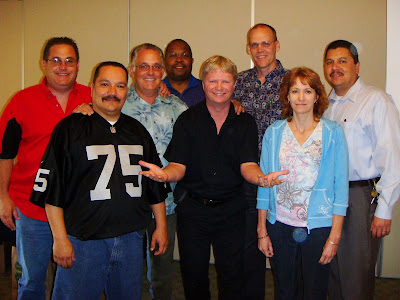
My new friends from CDCR
(California Department of Corrections and Rehabilitation)
Dale, Eddie, Dennis, Ken, me, Todd, Cindy, Ralph

Now it's time to commit to the material. We have to stand up and deliver 20 minutes of content. My section covers Practice 2: Inspire a Shared Vision.
Teach-backs are my favorite part of facilitator training. It's very rewarding to watch a number of people provide a new 'window' into the material.
Often, when they start, I think, "I would never do it this way. What are they thinking?" By the time they finish, however, I'm thinking, "Wow! I'm going to do it this way."

Today was no exception. All the presenters (and this isn't always the case) were authentic and consistent with the material. As I result, I found some great ideas for delivering the material myself.
My section went well. I tried an exercise from the book that I'd never seen before. I wanted to see how it played out live. It turned out very well, so I'll use it with my first session.

It's great getting a safe environment to experiment in.

Friday, June 27th

Apparently, one of us is "Leadership Allen".
This photo is with Mark Springer. Mark heads up a company in Montana that does disaster recovery.

I've spent quite a bit of time with Mark over the past few days, and learned a lot from from his curiosity, energy, and intensity. We've made plans to spend some time with Mark to share some of our practices and tap into his expertise in crisis management.

I don't want to downplay our standard business 'crisis', because any business decision in our company effects 6,000 employees directly and countless others indirectly - but talking to Mark about the work behind disaster recovery puts our problems into perspective, which is always a good thing.

Today, we did 'speed-leads' - 3 to 5 minutes teach-backs of the material - with video cameras running. Again it was a lot of fun. So many great presentations.

I have to comment on Todd's presentation. Todd is one of my new corrections friends. He started his presentation by falling on the ground and proclaiming, "Everytime I fall down, I'm 6 feet 4 inches closer to success." True words demonstrated with conviction.

I'm still digesting all that I took in over these four days.
By all, I mean the material, the Somona Valley, the wine, the food, the time with Ken and Brent, the new friendships, the experience of watching others present, and the ambiance that you only get in a room full of facilitators who believe in the material.

That's a lot... I'm sure I'll have many comments in days to come.