Showing posts with label culture. Show all posts

Tuesday, January 12, 2010

Le Grand Tour D'Asia: Day 5 of 58

Tuesday, January 12th

Learning Moment: Singapore

Timeliness obviously varies by culture.

I was reminded of this fact yesterday, as I led the slide:ology workshop in Singapore.
The workshop was scheduled to start at 9:00 am.
At 9:15, I had just over half of the attendees present, so I started.
The room was full around 9:30.

When I gave a 10-minute break in the morning, most of the attendees took 20-25 minutes.

For lunch, I gave a 70-minute break, saying "be back by 1:30".
We didn't get started until 2:00.

Finally, I got smart. I gave a 7-minute break in the afternoon - just enough time to reach the coffee machine and restroom. Then I didn't give the last break that I usually provide.

Sure, I could get angry and threaten, but that doesn't support a learning atmosphere.
I just observe the behavior, comment on it, and let them know that any chance to end early is decreased by their tardiness.

If that doesn't work, I just adjust the material a little, trimming time for exercises, and keep on teaching...


Thursday, December 25, 2008

Rambutan, Rambutan, My Kingdom for a Rambutan...

We're usually in Asia around this time of year.

This year, however, we have no plans to cross the Pacific...

That's a bummer, because right now I'm in the mood for some rambutan.

Because I'm a glutton for punishment, I decided to read about rambutan.
In my search, I found this (FREE) 59 page guide, "Fruits in Thailand". 

This'll get you wanting some sala, tamarind, or my favorite - Pomelo.

Download and enjoy!

Image courtesy of RedDogRambutan


Sunday, December 14, 2008

Where Am I?

It's one of my pet peeves of travel:
'International' hotel design.

While I think it's supposed to convey sophistication, it only implies a lack of imagination.
When I wake up, I like to have some visual cues as to where the hell I am... but most hotels don't give me those cues.


Here are Four Hotels in Four Countries around the globe. Nice rooms. Nice hotels.


But can you tell me where they are?
I bet you can't.

Let's list all the possible places where the visual cues could be placed:
  • The Floor - carpet design, fabric, or wood
  • The Walls - color, texture, pattern, paper
  • Lamps
  • Furniture - bed, chairs, tables, etc.
  • Art - vases, paintings, carvings
  • Fabrics- bedspread, curtains, pillows

These hotels either ignored the possiblities, or shopped at the kind of bland interior design shop that could be found in the back aisles at Sears.

The question I always ask is, "Why?"

Is it really easier to buy fake French furniture than to souce local materials?
Are there still travelers who want every hotel room to be the same for consistency sake?
It can't be because this makes people feel at home... whose home looks like this?

Here's a free idea for hotels trying to differentiate themselves:
Hang two digital frames in each room. Let guests (maybe just members?) log on to the website and pick their art.

In Hawaii, I can choose Kim Taylor-Reece, Vintage Hula posters, upload family photos, or - if I'm really lame - pick from the 'cute cat collection'.
In Japan, I can choose from Hokusai, vintage Kurosawa posters, scenes of Mt. Fuji, or geisha.
And you can always have the default Monet's lilies, for people who don't want to think...


As ESPN's Bill Simmons would say, "Someone needs to make this happen"!


Friday, December 12, 2008

Every Day a Surprise

I'm often asked, "What was the best part of living in Japan for 8 years?"

I can't possibly pick just one thing - so my stock answer is this:
Every single day that we lived in Japan, we saw something - sometimes small, sometimes big - that we'd never seen before.
That's not an exaggeration. Every day. 

It might be a hamburger served on rice buns (I don't mean buns made of rice, I mean rice formed into buns - if that makes sense). It might be a man walking his pet chipmunk. It might be an ancient ceremony. It might be a tee-shirt that says, "Happy Love Clams". It might be a man marching around a festival with no pants (as my buddy Martin is pointing out in this photo from the Yokohama Matsuri).
You just never knew.

Often, our surprise would come in the form of a TV show or a movie.
If you've only watched movies by Kurosawa and Ozu (and you should see these), you have no idea what kind of wonderful weirdness is manifested in Japanese cinema.

Sometimes I worry that Japan is becoming too Western - but I shouldn't worry.
Here's a trailer for a new movie in Japan, called "Love Exposure".

If you have delicate sensibilities, don't watch. 
It features a priests son who, apparently, is the Bruce Lee of 'upskirt' photography. If that doesn't make sense now, it soon will.


If you want to advance your view of the Japanese beyond stereotypes of samurai salarymen and dutiful housewives, watch these five Japanese films.


Monday, December 1, 2008

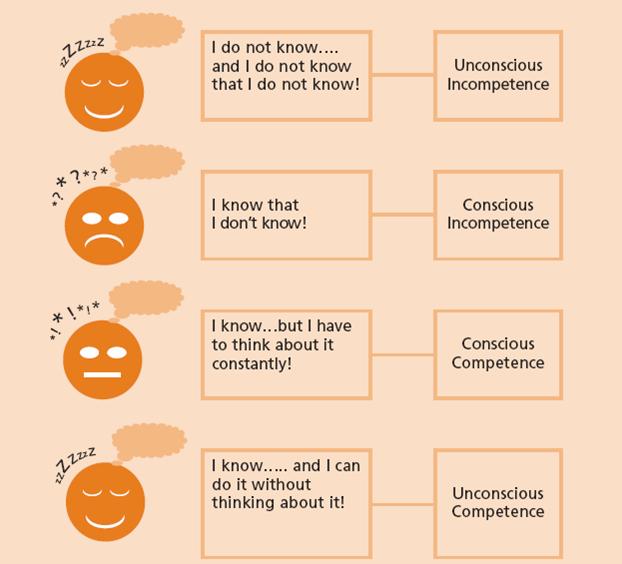
Conscious Competence - A Path of Learning

One of the most-used models in my toolbox is the 'Unconscious Competence' Model.

I find it to be an excellent model for cultural dealings.

When I first went to Japan in a state of Unconscious Incompetence, I made many, many mistakes that I only became aware of later.
I wasn't nearly humble enough, or quiet enough. I was also waaaay too casual.

I remember pointing out - at a Toshiba business meeting - that a female Toshiba engineer had a Winnie the Pooh pen. "Pooh-san", I cheerfully remarked. Needless to say, I drew silent stares in return.

Then I moved into the state of Conscious Incompetence. This was the stage when I kept wearing my shoes into the wrong places. I knew better, but I would always catch myself three steps into the wrong area. Bad Glenn! Bad!

Gradually, I reached Conscious Competence. I got the shoe culture down. I stopped pouring soy sauce on my rice. I didn't get lost on trains. But, I always had to think about it.

Finally, I reached the glorious state of Unconscious Competence (in at least some areas). Unfortunately, it was just in time to return to the U.S.
Now I found my unconscious skills allowed me to say 'Hai' to Americans, suck wind when I needed to say no, and stand around like an idiot waiting for taxi doors to open automatically.

Ah well, it's the journey that matters; not the destination.


Friday, November 21, 2008

Triple Your Spanish Vocabulary! Guaranteed or your Money Back!

We fly today to Cabo San Lucas (pictured to the right) for a little RnR at the Hilton Los Cabos Resort.

I love the collision of desert and ocean that occurs in Baja, so I'm really looking forward to this.

Ceviche, chorizos, chipotle, and chiquitas!
Time to start rolling my r's...

Speaking of which, I can triple the average Spanish vocabulary in one easy step.
I learned this in Mexico in 1991.

We were in Loreto, watching a parade of some type.
It looked like an election, so I asked an older Mexican man who was standing next to me.
Me: "Election?"
Him: "No comprende"
Me: "ELECTION?"
Him: "No comprende"
Me: "E... LEC...TION?"
Him: (shakes his head)

Finally, the proverbial light bulb appears above my head.
Me: "Eleccion?"
Him: as if discovering a dog could talk, "Si! Si! Eleccion!"

I realized that if I took every english word that ends with '-tion' and turned it to '-cion', I was now a master of Spanish.
I could go to the estacion and have a conversacion with the populacion of Mexico!!!

Viva '-cion'!


Friday, November 14, 2008

Learning through Film: Mushi-shi

Mushi-shi is an animation series based on a best-selling Japanese manga or graphic novel.

Set in an ambiguous time frame - it looks like the past, but feels contemporary - this series follows our hero Ginko, a wanderer who studies mushi: ghost-like creatures who live on the continuum between plant and animal.

Most people cannot see mushi, and are unaware of their existence, but they can affect humans greatly. Ginko can see them and he attracts them, so he has become a Mushi-shi.

This series has an X-files feel. In each episode we are presented with a problem or mystery that only Ginko can understand or address.

The series unfolds like a Japanese scroll, revealing secrets at its own pace. There is little action, yet each episode moves quickly. The feeling is philosophical and contemplative, the art is stunning, and the music is beautiful. Mushi-shi is, in simple terms, a masterpiece of its genre. A quick search on the internet will show you the universal acclaim it has earned.

You can learn quite a bit about Japanese culture from almost every episode. One of my favorites is episode #23, "The Sound of Rust". A young girl has an unusual singing voice that attracts a species of mushi. This mushi acts like rust and clings to everything in her village, including people (but is invisible to everyone except the girl and eventually Ginko). The girl stops singing or talking.

When Ginko enters the story, she is a young woman. The villagers are crippled my the mushi, and Ginko arrives to help. Ginko thinks he knows the cure and resolves to solve the problem.
In a scene we've all watched in movies a hundred times, the villagers now understand the cause of their problem, and rush to the young girls house, angry at this 'monster' for causing their pain.

Do they want blood? No.
Do they want revenge? No.
What do they want? An apology...

You know, just like in Frankenstein when the villagers rushed the castle with torches and asked for an apology!

This is a very Japanese phenomenon. Japanese love apologies.
If you mess up on your taxes, or any kind of government paperwork (I was once late for visa renewal) you must write a "gomennasai" (apology) letter.
"I'm sorry I caused the good people of the government so much difficulty due to my lack of consideration... blah, blah, blah...."
When you've shown proper humility, the process can move on.

When I lived in Japan, it seemed we were forever attending these "gomennasai" meetings with customers.
"I'm sorry we charge so much"
"I'm sorry the manuals are in English"
"I'm sorry your engineers broke the machine"

And so on... I actually became quite good at looking and sounding remorseful.

A couple of years ago, Hideki Matsui of the New York Yankees broke his wrist on a diving attempt to catch a ball. He would be out for the season. He called a press conference and apologized to his team, the fans, and his Japanese fans for letting them down by being so vulnerable as to have a season-ending injury.
The New York media was stunned by this apology... they'd never seen anything like it.
This article in the Japan Times nicely summarizes the 'apology' gap.

Bottom line: Next time you have a problem working in Japan and you want to resolve it - you might want to start with 'gomennasai'.


Friday, October 31, 2008

How to build Relationships in a Virtual Team? Table Topics


I found this in Sonoma, in a gift shop at the Fairmont Sonoma Mission Inn and Spa. I bought it immediately.

One of the challenges with distributed teams is that you never have the 'little' conversations that build rapport.

Conversations like:
"Is golf a sport?"
"A burger cannot be made of tofu."
Or "How would I look with a beard?"

A recommendation I often make to virtual teams is to ask a 'get to know you' question at the start of every staff meeting. This sounds good in practice, but eventually you run out of questions.

Well, that's no longer a problem.
TableTopics sells box sets with 135 questions for US$25.
Buy a box. My suggestion is to get the 'original version' for your team, expense it, and start using it.


I did this exercise with my peers and learned about the strangest weather that Henry, our learning partner in Taiwan, ever saw.
He went into a factory in China on a cloudy day and worked all day. When he left, something was different, but he couldn't put his finger on it. Suddenly, he noticed that everything was white and realized that this was snow! He'd never seen it before.

I've known Henry for years, but had never heard this story.
You learn just as much from how someone tells a story as from the story itself.

Get to know your teammates (you might learn something).


Friday, October 24, 2008

Wisdom from the Tao Teh Ching

I occasionally like to wander through Lao Tzu's "Tao Te Ching".

Two passages always stand out to me.
By not exalting the talented you will cause the people to cease from rivalry and contention.
By not prizing goods hard to get, you will cause the people to cease from robbing and stealing.
By not displaying what is desirable, you will cause the people's hearts to remain undisturbed
.
When I read this, I always think of Japan.
I see Japan as one of the least status-conscious of countries.
Though they like to buy designer names, it's in an effort to fit in with a fad; rather than to stand apart from the crowds.

And it does seem to leave them with 'undisturbed hearts'.

As for the second passage -

Wherever armies are stationed, thorny bushes grow.
After a great war, bad years invariably follow.

What you want is to protect efficiently your own state, but not to aim at self-aggrandisement.

After you have attained your purpose, you must not parade your success, you must not boast of your ability, you must not feel proud.
You must rather regret that you had not been able to prevent the war.

You must never think of conquering others by force. For to be
over-developed is to hasten decay,
And this is against Tao,

And what is against Tao will soon cease to be.

Hmmmm....
Written more than 2000 years ago...


Friday, October 17, 2008

Learn How to Eat Sushi

My friend Joon Chung shared this hilariously dry video with me a few years ago.

It's a mock instructional film called "Sushi-ya"

Watch and learn how to eat sushi (and please don't take it seriously)!!
Thanks Joon!


It's a good test of your cultural savvy to see how many of the 'jokes' you get.
According to this article, there are 5 types of humor.
In this video, do you see:
  • Puns?
  • Exaggeration?
  • Surprise?
  • Silliness?
  • Put-Downs?

Looking at how the Japanese handle humor in this clip, what can you learn?


Wednesday, October 15, 2008

Range of Vision - The World Through My Lens

This is a continuing series of slideshows from my travels. Enjoy!


Range of Vision 2.o - Wildlife

Here are some of my favorite wildlife photos that I've taken.


Range of Vision 1.o - Images of Asia
I meet a lot of people as I travel throughout Asia and the world, and I take a lot of photos of them. Here are 125 of my favorite people photos .


Technical/design note:
I've been struggling for years with how best to present my photos.
I don't like just hanging them up on the web where anyone can download and use them.
On the other hand, I want friends, family and colleagues to be able to see the images.

My compromises has been:
  • to post small photos, like I did at rangeofvision (too small)
  • to watermark the images, like I do at hues.smugmug.com and deviantart.com (too distracting)
  • to use a password-protected gallery and send out invite (too restrictive)

None of these were satisfactory, so I'm trying a different option - photos presented as video, assembled using Picasa software..

Let me know what you think!


Sunday, October 12, 2008

Is Your Offering Kawaii?

Kawaii art by Yumiko Kayukawa

Anyone who desires to 'understand' Japan will eventually have to deal with the concept of 'kawaii' - a concept so profound that it has a wikipedia entry that is annotated with references from Wired, Business Week, TimeAsia and The New Yorker.

What deep Japanese value has the elite press so abuzz?
The concept of 'cute'.

You may have already known, without being told, that cute is big in Japan.
If that doesn't quite jib with the stomach-slicing vision of corporate samurai that you're used to, well, maybe you don't watch enough anime (where cuteness and violence walked hand-in-hand way before Angelina Jolie climbed into Lara Crofts shorts)...

Hello Kitty, Pokemon, Aya Ueto, and Kimu-taku are merely the tip of the (probably pink and fuzzy) cuteness iceberg that is Japanese pop culture...

I have a phrase I'm fond of repeating regarding J-pop culture -
"If it ain't cute, give it the boot!"

I could try to explain what it is, why it's important (to the Japanese anyway), what conclusions we should draw, etc.... but I'm neither inclined nor equipped to.

I just say - recognize it, enjoy it, and use it.
So, in that vein, I will point you in the direction of 2 sunny sources (I almost wrote 'nuclear power plants' but that wouldn't be cute, would it?) of 'kawaii'.
  1. "Kamikaze Girls" - this film, easily available on dvd in the US, is laugh-out-loud funny, with brilliant direction and excellent characters. Kyoko Fukada is perfect as the 'kawaii' half of this odd-couple duo, with Anna Tsuchiya capably handling the 'tough' girl (she won a bunch of 'best newcomer' awards for her performance and, by-the-way, her cd outrocks Avril Lavigne by quite a bit).
    This film is your 'kawaii' litmus test. If you find this film unbearably cute... oh, well...
    It says a lot that this film has a 7.5/10 rating on the Internet Movie Database. If you have a taste for quirky films, don't miss it...
  2. Yumiko Kayukawa is the creator of the 'kawaii' image at the top of this entry. Reminding me of the late, great Patrick Nagel, I'm a sucker for this kind of stuff (just like I'm a sucker for coca-cola, coconut ice-cream - well, coconut anything, jelly-filled donuts, and other sweet-stuff). Plenty more of these images on her website...

If you think 'kawaii' is too girly for you or your product, try this list of names on:

Cute didn't hurt any of those products...

In fact, MangaGlenn gives them a big thumbs up!
I created this 'mangatar' or 'manga avatar' at FaceYourManga.com.

Take a look around you. Measure the 'cuteness' of products you see and evaluate yours.

And once again, I'll ask: Is your offering kawaii enough?


Saturday, October 11, 2008

What can we Learn from Music? An Okinawan Melody

Making Friends near Manza Beach on Okinawa Island...

Anytime I go home, I share some music with my dad.
Two years ago, we watched a live Foo Fighters show on high def and an hour special on the Red Hot Chili Peppers. He enjoyed both, though he probably wouldn't be able to pick them out of a police lineup today.

This year, I shared some Okinawan music with him. 
He was eating lunch, but immediately looked up and said, "Now that, I like. It's got a melody."

Ah, yes, the melody...
The melody was always king in the Hughes household. There was often music coming from the record player. I heard a lot of Burt Bacharach when I was growing up. And Herb Alpert (Casino Royale and A Taste of Honey always make me smile)... Louis Armstrong and Frank Sinatra... Tom Jones...
You always walked away humming.

While my brother got into hard rock and heavy metal, I never wandered far from the melody. For all my life, I've been drawn to tunesmiths - The Who, Neil Finn, Nirvana, Snow Patrol, Tom Petty, Bruce, Aerosmith, Green Day, Bad Company, The Eagles, Damien Rice, Bangles, Beatles, Beach Boys, Peter Gabriel, Def Leppard, Chili Peppers, Foo Fighters, Cheap Trick, Sigur Ros, Stone Temple Pilots, Third Eye Blind, Tom McRae, Tori Amos, U2...
I could keep going...

I can appreciate Metalica and rap and disco and country and jazz, but I can't love them.
None of those are ear candy. None of those have, as one critic said of UFO (Lights Out, Love to Love to Love You), "more hooks than a meat market".

Anyway, when I introduce music to my dad, I make sure it's got a melody.
Here's "Sanshin No Hana" from a popular Okinawan band called Begin.


There's a lot we can learn from music.
Here are some questions for you to think about:
  • What's your hook - for you, your product, or your presentation?
  • Is it as clear or catchy as a good song chorus?
  • Does your audience walk away singing your song? 
  • If not, why not?
  • What can you do to strengthen your hook?


Friday, October 10, 2008

A Workbook for Learning About Culture

I lived in Asia for over 10 years, so I know how challenging an expat assignment can be.
In this global economy, the odds are higher than ever that you will work overseas, or that the person next to you is currently working overseas.

For those of you who are going, are thinking about going, or just spend so much time overseas that you feel like you live there - here is an excellent resource.

The Peace Corps probably has as much experience at sending people overseas as any organization on earth. So, it makes sense that they would have some tools for preparing people to work with other cultures.

Here is the 266 page workbook that the Peace Corps uses.
And it's a FREE DOWNLOAD!!


It's called Culture Matters.

It covers just about everything you would ever want to know about culture. I cover many of these same points in my "CultureCoach" workshops.

If you are going on an assignment of more than 6 months, I would highly recommend completing the book. If you bring a family, do it together.


Saturday, October 4, 2008

How To Be Global (Part Two): A Reference Library

Making friends in Seoul, South Korea

Yesterday, I mentioned that in this global environment, we're all similar and yet we're all different.
One example of that is that we all like music and movies - but different cultures will like different kinds of music and movies.

One of my favorite ways to bridge the culture gap is to learn about popular music and cinema in the countries that I visit and work in.
I often open a conversation or presentation by discussing the movie I just saw.
It builds rapport, as most Indians, Chinese, Koreans or Japanese can't believe that you'd actually watch a local movie. If you actually like it, they're thrilled!

In that spirit, I've made a list at Amazon of my favorite Asian books, movies and music.
But hey, if it's art or sports that makes you tick - then go that direction.


You can find plenty of clips of the bands and singers on YouTube. 
I'll whet your appetite with Anggun, from Indonesia, singing "Snow on the Sahara".


Friday, October 3, 2008

How to be Global in Three Easy Steps...

It's a global world. How do we live in it?
Here are three ways:

1. Assume that there are differences.

You can't be global by believing that everyone is just like you.
Not everyone talks like you or listens like you, eats like you or uses a toilet like you, sleeps like you or wakes like you, thinks like you or judges like you, was raised like you or raises children like you do, watches TV programs like you do unless it's American Idol in which case they do, dances like you or stands in the corner making fun of people who dance like you do, drives like you or walks like you, writes like you or reads like you, works like you or plays like you, swears like you or prays like you, laughs like you or cries like you, loves like you or hates like you, lives like you or dies like you.

People are different. Jump in anyway.
You'll make some mistakes and eat some really weird stuff. So what?

2. Assume that there are no differences

You can't be global by believing that everyone is different from you.
We all talk and listen. We all eat and defecate. We all sleep and wake. We all think and judge. We all dance or don't dance. We all work and play, read and write, swear and pray, laugh and cry, and love and hate. We all live and die.

Everyone laughs at mistakes and everyone loves a good sport.

3. Go mix! Embrace the differences and similarities through relationships...

It's a big world and you'll run out of time before you run out of world.

Where The Hell Is Matt? is a perfect example of being global.


I smile every time I see it this video. Given it's popularity, it's clear that many people have a similar reaction.

Matt leverages our similarities, embraces our differences, and builds relationships.

I don't mean to oversimplify, but everything else is nuance...


Friday, September 26, 2008

What's your Cultural IQ?

Have you traveled much?
You've done business in multiple countries?

Maybe you haven't traveled, but you've been exposed to many different cultures.

Do you consider youself Culturally savvy?

Let's find out...

Here's a short test of your global culture knowledge in a variety of business settings.

http://leadershipcrossroads.com/rs_quiz.htm

I did rather poorly - 10/20. I nailed the Asia questions, but didn't do well on the Europe questions. Not surprising, I guess, as I've never been to Europe.

Good luck!


Friday, September 19, 2008

Learning Culture Through Film: Maiko Haaaan!!!

This week's ‘Learning Culture Through Film’ Feature is “Maiko Haaaan!!!" a Japanese comedy about a loser who moves from Tokyo to Kyoto to chase geisha, prompting his jilted girlfriend to follow and try to become a geisha.

As is my custom, I won’t review the film - you can find reviews here. Rather, I want to highlight what you might be able to learn about Japanese culture, by watching "Maiko Haaaan!!!".

To do this, I'll discuss three scenes from the movie, using a facilitator's debriefing strategy called 'What, So What, Now What'.

'What' - asks what happened?
'So what' - asks what that means and why it matters?
'Now what' - asks what you can do differently in work or life, based on this knowledge?

SPOILER ALERT – If you don't want to read plot spoilers, stop now!

1. We see our ‘hero’ get transferred to the Kyoto branch of his company.
What - The main character is working in Tokyo, when he gets transferred to Kyoto.
So What - Getting transferred from HQ to a regional office is a clear message that you are a poor performer. In a society that doesn't like to fire people, moving them to a branch office is the next best thing.
Now What - Be aware of the social status of branch offices. Moving an employee away from HQ to drive a new office, for example, may not be met with enthusiasm. What you intend as an honor might be taken as a message that you're trying to get rid of the employee.

2. We see our ‘hero’ and other photographers chasing geisha through the streets for a photo.
What - We see a ridiculous grown men running through the streets of Kyoto, acting like obnoxious little kids or paparazzi, as they take photos of geisha.
So What - This really happens. I know that because, umm, I've been that guy. Photographers stalk the streets looking for a shot of this 'lost' icon of Japan's past. Seriously, it's a big dea. Most Japanese have never seen a geisha. It's like seeing Angelina Jolie...
Now What - Realize that seeing a geisha in Japan is like seeing an American Indian. Yeah, they were everywhere at one time, but not so common now. And when you do see them... they probably won't look (or act) like you expect.


Well, yeah, I might have chased a couple geisha around (for a photo...)

3. We see the boss introduce his employee into the geisha world.
What - Our 'hero' can't get into a geisha house until his boss brings him there.
So What - When an employee enters the workforce, it's common for the boss to become his new 'father'. The boss might introduce him to a female employees as a potential wife. The boss might also take him to restaurants or nightspots and introduce him.
Now What - Don't be surprised if you see Japanese managers taking a paternal view of their employees. Don't be surprised if you Japanese employees come to you with questions of a somewhat personal nature. I had Japanese employees ask me for financial advice, relationship advice, travel advice, and more. There were a few times I was stunned at some of what they asked. Bottom line - it's part of the responsibility of a manager.


Someone said all comedy is based on truth, so look for the truth in the comedies you watch and see what you can learn from them.
Have you learned about culture from a film? Tell us what you've learned.


Friday, September 12, 2008

Do you "Gross Out The World"?

My better half, Angie, doesn't!
Angie knows how to eat noodles in Japan, as she demonstrates in this photo from a Yokohama shop.

Since Friday is culture day at huesworks, we'll see if you are as adept as she is.

"Don't Gross Out the World" is a short, fun site that tests your global dining etiquette.

It's also well designed, and easy to use - a great way to learn.
Enjoy!!


Saturday, September 6, 2008

Pie Chart Humor at GraphJam

GraphJam is brilliant.
This collection of pop-culture humor set to pie-charts is a winner in every respect.

Think about how you might be able to use this type of chart to add a little humor to your presentation, without resorting to 'joke-telling'.

Check it the site. There's much more where this came from.
Watch out though, it's addictive.

song chart memes
more music charts