Showing posts with label art. Show all posts

Thursday, February 11, 2010

Le Grand Tour D'Asia: Day 35 of 58

Thursday, February 11th
Learning Moment: Bali, Indonesia

Today was another busy day.

I visited the monkey forest and got some free grooming from a new little pal.
Angie and I walked about 5 miles - from Ubud, through Peliatan, and back.
And we bought a pile of paintings...

Two things that I was reminded of:

First, it's hard to get a better bargain for your art dollar than the one you'll find in Bali.
We got five paintings of Balinese dancers, including the one on the left, for about US$65.

Second, I would never try to make my living as an artist. Barriers to market entry are approximately zero. Branding is almost impossible. It's really difficult to articulate the 'value' of your product. And everyone (along with their sisters) believes they are either an artist or an art critic.

There's got to be an easier way to make a living...


Tuesday, September 8, 2009

I draw to see...

I like to draw.

But it isn't because I'm good at it...

I like to draw bcause it forces me to look more closely at the world around me. I don't spend enough time drawing, but - then again - I don't spend enough time doing anything.

At dinner the other night, I pulled out my index cards (don't leave home without them!) and drew this 2-minute sketch of Anige. I wish I was more confident in my strokes, but it captured the way she looked at that moment and I'll take that.

You can't draw and not look... at least I can't.
If nothing else, that's the gift that drawing gives me: focus.

Drawing forces me to be in the moment. To stop. Look. Reflect. And make a connection from my eyes to my brain to my hands (hopefully with a quick stop at the heart, but who can say?). Isn't that a pretty good description of learning?


Sunday, July 19, 2009

Restroom Iconography XII: Santa Clara, CA

Yes, it's time for another addition to my ongoing collection of restroom icons.


This one comes from "La Paloma", our favorite neighborhood Mexican restaurant: home of amazing chorizo con huevos, excellent flan, a dozen camarone dishes, and my favorite long island iced tea.

Oh yeah, and a very, very cool staff.

Anyway... we've been going there for over 6 years now, but I hadn't shot the restroom icons until tonight.

This, of course, is the restroom for senoras and senoritas.
Everytime I shoot one of these, I worry that a woman will open the door and scream, just as I'm shooting the photo.

It hasn't happened yet, but it's inevitable, isn't it?

On the other hand, it might actually be worse if I caught a photo of some dude exiting the mens room, while I'm shooting the horn-tootin' hombre here!

I guess that's just proof that to be an artist is to take risks?

Ah, yes... We must all suffer for our art...


Tuesday, June 9, 2009

Visual Ethnography, Art, Obsession, and Inspiration

While in New Mexico, I renewed my fascination with the photography of Edward S. Curtis.

If you don't know his name, you certainly know at least a few of his remarkable photographs.

I just finished reading "Shadow Catcher: The Life and Work of Edward S. Curtis", an excellent overview of the man's obsessive journey to capture the Indian way of life. 
He spent 23 years (1907-1930) chasing these images and basically went broke in the process. 
It's a dramatic story, to say the least. 

But not a sad one. 
From all accounts, Curtis loved what he did and did what he loved. From this I take inspiration.
He was, without question, a remarkable man who produced remarkable images.

In regards to his work, I'll quote George Bird Grinnell, who said, "The results which Curtis gets with his camera stir one as one is stirred by a great painting. When we are thus moved by a picture, and share the thought and feeling that the artist had when he made the picture, we may recognize it as a work of art."

Amen, brother...


Sunday, April 26, 2009

Graffiti Practice!!

Ever want to be a graffiti artist, but don't have the balls to actually deface public property?


If that description fits you, today is your lucky day!

Fakeproject Corporation (what a great name...) has a free downloadable coloring book for aspiring graffiti artists.

Practice tagging without getting tagged!

*This is one of my favorite graffiti images of all time. It's a painting of Musashi Miyamoto (as portrayed by actor Mifune Toshiro). This was on the retaining wall for the train tracks at Sakuragicho Station in Yokohama, Japan - a particularly fertile location for graffiti.


Wednesday, April 1, 2009

The Art of Argument

While Angie and I were camping last week, we had the 'pleasure' of listening to an argument in a nearby campsite.


As we talked the next day, we decided that there were 6 reasons why people argue:
  1. Because they're right - these folks fall into three categories:
    a) Those that know they are right. Stay away from them. You aren't going to get anywhere, unless you're engaging in a Type 4 argument (having fun). In that case, party on!
    b) Those that think they are right. You can actually have a productive argument with someone who thinks they are right.
    c) Those that want to be right. Someone who's arguing about something they love (like family or religion) might fall in this category. You should ask yourself if this is an argument you're willing to win. The fallout may be too great.
  2. Because you're wrong - These folks don't have a right answer. They just believe that you're wrong. You'd better have a great evidence, because you don't have any credibility with them on this issue.
  3. Because they're obstinate - They have a stance. They don't know if it's right. They don't care if you're wrong. They are not going to move.
  4. Because it's fun (for them) - I sometimes fall into this category. I like to argue for sport, with no attachment to outcome. And, I love to watch tightly strung people blow a gasket. If you're highly strung, you probably don't want to enter an argument with me or someone like me.
  5. Because they think the situation calls for a 'devils advocate' - It often helps to get an alternative point of view. Some people occupy this role strategically. Others do it as a way of life. Occasionally, the position is assigned to someone.
  6. Because it helps them think - Debating helps me think. I'll sometimes argue both sides of an issue within a half-hour. I'm not tied to any position yet.

You can see that it's pretty important to see why someone is arguing.
And, it's just as important to understand why you are arguing.
Purpose changes the dynamics.

So, next time you're in an argument, try asking, "Why?"


Sunday, November 2, 2008

Book Review: The Adventures of Johnny Bunko

Daniel H. Pink's A Whole New Mind is one of my favorite books. He's an engaging writer and he picks interesting and important topics.

I drove straight to the bookstore when I heard that his new book, The Adventures of Johnny Bunko - a career guide done in manga (Japanese comics) style - was released.

I've read a few manga - Shirow Masamune's Ghost in the Shell holds a prominent spot on my bookshelf. enjoy the manga, the anime movies and the video series... I've even got a Major Kusanagi action figure on my bookshelf - but I'm not what you'd call a hardcore manga fan.

Major Motoko Kusanagi
Ghost in the Shell's Heroine protects my books

Still, you'd have to be blind not to see that visual communication is the next big wave in learning, and manga is a leading edge of that wave.
Hence, my interest in Johnny Bunko. I bought it and read it in one sitting.

Title: "The Adventures of Johnny Bunko"
Author: Daniel H. Pink
Genre: Manga, Business, Careers
Summary: to quote the book's subtitle, "The Last Career Guide You'll Ever Need"

Favorite Quote: I have two - "There is no plan" and "Make excellent mistakes".

Strengths: Well, I applaud Mr. Pink for innovating. It's not without risk to write a non-fiction book in manga format. On the other hand, his audience - new college graduates - is ready for this. And the message is right on target. I don't have any major disagreements with the content.
Weaknesses: All the learning in this book could have fit in a manifesto (manifestos rock!!).
This, essentially, is an article, not a book.

Ghost in the Shell proved that a manga doesn't have to be simple or dumb.
In fact, I guarantee that you'll learn more and think more during a reading of Ghost in the Shell than you will in Johnny Bunko.

Conclusion: Maybe Johnny Bunko is the baby step we need to launch the next visual learning wave - but if you're interested in riding that wave, I'd suggest you pick up one of these:

  • Ghost in the Shell - the science fiction manga that inspired "The Matrix"
  • Understanding Comics - Scott McCloud's overview of comics as a visual language is proof you can learn through pictures.
  • Flight Volume 2 - This anthology of 'sequential art' - as Will Eisner termed it - is inspired and inspiring. If you wonder what the medium is capable of - look here.

Post-it Flags: 1 flag
* Each time I find an interesting quote, model, image, or idea in a book, I mark it with a Post-it flag. The more flags, the more value I found in the book.


Friday, October 24, 2008

Weird isn't Good.... Weird isn't Great... Weird is Mandatory!

In his speech that's captured on the DVD "Tom Peters Live: Re-imagine! Business Excellence in a Disruptive Age", Tom is adamant that we need to surround ourselves with the lunatic fringe. 


Everything important comes from the edge... not the middle.

His comments reminded me... a couple months ago, in Pt. Reyes Station, I bought a book. The cover caught my eye - like seeing a familiar face in an airport. Not quite a friend, just something confusingly familiar. 

Oh, yeah... I remember you, I thought. It was the art of Lynda Barry. I remembered her art from 'underground' newspapers in the late 80's, early 90's - before I moved to Asia.

She was in the same papers that carried pre-Simpsons Matt Groening's strip "Life in Hell". I loved Life in Hell. Lynda's work however, freaked me out a little. Still, I found myself compelled to read it every week - like looking at a traffic accident.

Anyway, I bought the book. And guess what? It's incredible.
Did she change? Or did I change?
Maybe my years in Japan opened me to her approach?
Does it matter? I wonder...

Here are five lines from the book that particularly grabbed me:
  • "The thing I call 'my mind' seems to be kind of like a landlord that doesn't really know its tenants"
  • "What year is it in your imagination?"
  • "Something can only become an illusion after disillusionment. Before that, it is something real."
  • "What do drawing, singing, dancing, music making, handwriting, playing, story writing, acting, remembering, and even dreaming all have in common? They come about when a certain person in a certain place in a certain time arranges certain uncertainties into certain form."
  • "I believe this happens to most of us. We are still singing, but secretly and all alone."

Buy this book for the art. Buy this book for the writing. 
Buy this book to free your mind. Buy this book because it frightens you. 
Frankly, I don't care why you buy this book.
But... buy this book...


Sunday, October 12, 2008

Is Your Offering Kawaii?

Kawaii art by Yumiko Kayukawa

Anyone who desires to 'understand' Japan will eventually have to deal with the concept of 'kawaii' - a concept so profound that it has a wikipedia entry that is annotated with references from Wired, Business Week, TimeAsia and The New Yorker.

What deep Japanese value has the elite press so abuzz?
The concept of 'cute'.

You may have already known, without being told, that cute is big in Japan.
If that doesn't quite jib with the stomach-slicing vision of corporate samurai that you're used to, well, maybe you don't watch enough anime (where cuteness and violence walked hand-in-hand way before Angelina Jolie climbed into Lara Crofts shorts)...

Hello Kitty, Pokemon, Aya Ueto, and Kimu-taku are merely the tip of the (probably pink and fuzzy) cuteness iceberg that is Japanese pop culture...

I have a phrase I'm fond of repeating regarding J-pop culture -
"If it ain't cute, give it the boot!"

I could try to explain what it is, why it's important (to the Japanese anyway), what conclusions we should draw, etc.... but I'm neither inclined nor equipped to.

I just say - recognize it, enjoy it, and use it.
So, in that vein, I will point you in the direction of 2 sunny sources (I almost wrote 'nuclear power plants' but that wouldn't be cute, would it?) of 'kawaii'.
  1. "Kamikaze Girls" - this film, easily available on dvd in the US, is laugh-out-loud funny, with brilliant direction and excellent characters. Kyoko Fukada is perfect as the 'kawaii' half of this odd-couple duo, with Anna Tsuchiya capably handling the 'tough' girl (she won a bunch of 'best newcomer' awards for her performance and, by-the-way, her cd outrocks Avril Lavigne by quite a bit).
    This film is your 'kawaii' litmus test. If you find this film unbearably cute... oh, well...
    It says a lot that this film has a 7.5/10 rating on the Internet Movie Database. If you have a taste for quirky films, don't miss it...
  2. Yumiko Kayukawa is the creator of the 'kawaii' image at the top of this entry. Reminding me of the late, great Patrick Nagel, I'm a sucker for this kind of stuff (just like I'm a sucker for coca-cola, coconut ice-cream - well, coconut anything, jelly-filled donuts, and other sweet-stuff). Plenty more of these images on her website...

If you think 'kawaii' is too girly for you or your product, try this list of names on:

Cute didn't hurt any of those products...

In fact, MangaGlenn gives them a big thumbs up!
I created this 'mangatar' or 'manga avatar' at FaceYourManga.com.

Take a look around you. Measure the 'cuteness' of products you see and evaluate yours.

And once again, I'll ask: Is your offering kawaii enough?


Friday, October 10, 2008

Am I a Geek? Are You a Geek?

Yesterday, Barry Posner signed my 1st edition copy of The Leadership Challenge. 
Believe it or not, before I met him, I had to decide which edition I was going to ask him to sign - yes, I have all four editions...

In the afternoon, I stopped at the Recycle Bookstore in San Jose, and bought four more books to add to my reading pile.

Based on these two data points, I realize that if someone wanted to convict me of being a geek,  they could find some pretty strong evidence.
  1. I have an engineering degree.
  2. I read for fun.
  3. I don't just read, I collect books.
  4. I have three computers on my desk (powered up and ready to go)
  5. I like anime.
  6. I enjoy the occasional graphic novel, manga, or sequential art.
  7. I enjoy documentaries and foreign films.
  8. I have a large catalogued collection of dvds.
  9. I have a large catalogued collection of cds.
  10. I own a couple of action figures (Musashi Miyamoto and "Ghost in the Shell's" Major Motoko Kusanagi)
  11. I love maps.
  12. I love libraries.
  13. I have a sand (yes... sand) collection.
  14. I can program in BASIC and HTML.
  15. I've had a website since 1998.

Curious, I googled, "Are you a geek?" and "Are you a nerd?"
I took the GeekTest and scored at only 10.45365% (love the accuracy there).

Turns out I'm not even close. The lack of anti-social and fantasy attributes (no role playing games in my past, sorry) holds me back from reaching true geekdom.

How about you? Where do you score?


Wednesday, October 8, 2008

How Wild are You?


Wednesday is CIT (Creativity, Innovation, Thinking) day at huesworks (well, everyday is Creativity day, but on Wednesday, I write about it).


I'm in the process of designing a workshop, and I constantly ask myself whether I'm stepping far enough out of my usual patterns and assumptions when I design.

In that vein, I was reading through Eric Maisel's "Fearless Creating", and found this "wish list for nurturing our own wildness".

Treat it as a checklist and see how you score:
  1. Be asocial by holding society and its norms at arm's length.
  2. Think about big questions.
  3. Have high aspirations for yourself.
  4. Accept your own idiosyncratic goals.
  5. Feel autonomous.
  6. Do not conform.
  7. Be sensitive to human affairs.
  8. Be inquisitive.
  9. Be honest.
  10. Be intelligent.
  11. Be joyful.
  12. Demand originality from yourself.
  13. Be spontaneous.
  14. Rebel.
  15. Cultivate a strong self-image.
  16. Take risks.
  17. Be instinctive.
  18. Be passionate.
  19. Be stubborn.
  20. Be free.

How'd you do? Are you wild or mild?
Where can you stretch a little?

It might (or might not) surprise those around me, but I don't think I go far enough with numbers 1, 6, 14, and 18. I tend to take the path of least resistance.

I'm making a personal commitment to push through that temptation this time.


Saturday, October 4, 2008

How To Be Global (Part Two): A Reference Library

Making friends in Seoul, South Korea

Yesterday, I mentioned that in this global environment, we're all similar and yet we're all different.
One example of that is that we all like music and movies - but different cultures will like different kinds of music and movies.

One of my favorite ways to bridge the culture gap is to learn about popular music and cinema in the countries that I visit and work in.
I often open a conversation or presentation by discussing the movie I just saw.
It builds rapport, as most Indians, Chinese, Koreans or Japanese can't believe that you'd actually watch a local movie. If you actually like it, they're thrilled!

In that spirit, I've made a list at Amazon of my favorite Asian books, movies and music.
But hey, if it's art or sports that makes you tick - then go that direction.


You can find plenty of clips of the bands and singers on YouTube. 
I'll whet your appetite with Anggun, from Indonesia, singing "Snow on the Sahara".


Thursday, October 2, 2008

Visual Communication - Shout it Out


Deviant Art is perhaps the most vibrant art community on the web.
I often spend hours wandering through the site, and it's a rare visit where I won't stumble onto an inspiring image.

One of my favorite themes on DeviantArt is the 'Shout It Out' image.
A challenge started by one contributor - Shout It Out's stand at the crossroads of vision statements, mission statements, value statements, credos, slogans, cliches, art, and a random font generator. Hundreds of artists in the community have created a personal 'Shout Out'.

Even the 'worst' (an absolutely arbitrary word) are compelling, in a 'train-wreck' sort of way (you want to pass by, but you can't turn your head away).

If you're struggling with creating a vision or mission statement, or wonder how to articulate your values - one or more of these 'Shout it Out' images might kick start your brain.

Check some out.. I encourage you... (or dare you, if that helps)
You might even want to do your own...


Wednesday, May 31, 2006

Why Language is Overrated (from Seoul, Korea)

Yesterday was election day in Korea, so Angie and I had a chance to see some sights.
It was a beautiful day in Seoul - sunny and warm, with a cool breeze.

Our first stop was Unhyeongung Mansion, where we stumbled into a Pansori performance.
I heard a microphone check, walked over to see what was going on, and discovered this performance.

Pansori is a traditional storytelling method that is very rhythmic.
Think trance-rap, and you start to get close.

I love it, because the audience is encouraged to participate.
It can get a little rowdy, with the feeling of an Southern church (Amen, brother!!).

Anyway, we walked right into a front seat, and this vibrant woman put on a great performance for us.
She also sang Arirang and a few other songs; clapping, smiling, snapping her fan, and joking with the audience till she had us all laughing. 


I didn't understand a word, but it didn't matter.
Why is that true?
  • Because the rhythm spoke to my body
  • Because her body language communicated so much information
  • Because my fellow audience members signaled me with laughs, groans, and shrieks of delight
  • Because her eyes, smile, and face spoke a thousand words
  • Because melodies reach across all borders
  • Because the tone and pace of her voice was full of signals
  • Because she used her fan as a prop to signal us

How many of these tools do your use purposefully in your communications?
Not enough, if you're anything like me...
Give just one a try and see what happens.


If you want to see Pansori in action (and see a great movie), you should rent or buy "Chunhyang". It's Korea's Romeo and Juliet - an excellent story, beautifully filmed.

This lucky discovery reminded me once again:
Keep your eyes, ears (and heart) open, and you never know what you'll find.


Friday, March 10, 2006

Art and Context in Seoul, Korea

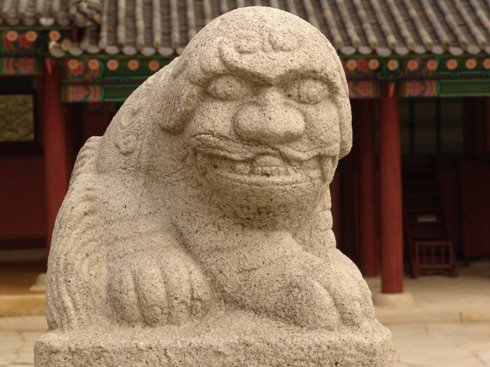
I have always had a fondness for the 'lion-dogs' of Asia.
I took this photo of one such creature at Gyeongbokgung Palace.

"Good art is always high-context; bad art, low-context. This is one reason why good art persists and art that releases its message all at once does not."

- Edward T. Hall "Beyond Culture"